







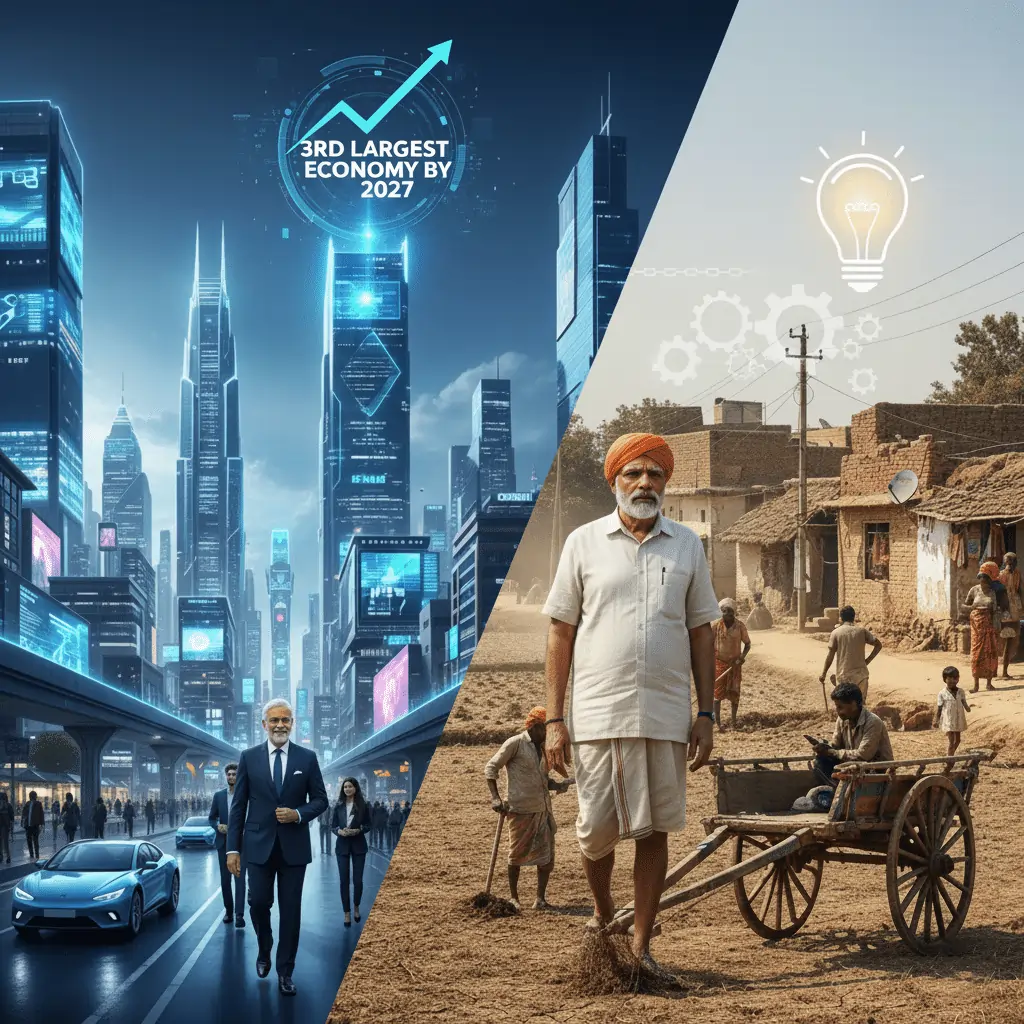
India is projected to become the world’s third-largest economy by 2027, reflecting a significant shift in its overall output but also masking a complex domestic economic landscape plagued by inequality and structural constraints. While India’s GDP is expected to surpass that of established European economies like Germany, this success is largely attributed to its large population and rapidly growing urban middle class, rather than a broader improvement in the national economy. Defining the distinction between a “large” and a “developed” economy remains a major challenge for the Indian government.
The phenomenon of “jobless growth” is of most concern to observers of the Indian economy. Even with high annual growth rates, the Indian economy fails to generate the needed amount of formal jobs for the millions of youths entering the economy each year. For almost three decades, the economy’s manufacturing sector has been stagnant, providing little mass employment at the other developing country levels of the economy. This means a large part of the workforce is relegated to low productivity “gig” informal economy jobs with no social protection and wage safety, or to agrarian informal jobs.
In the context of economic growth, socio-economic imbalances and inequality are major concern in the Indian economy. Reports in 2025 indicated over a century’s record of the richest 1% in the country owning almost 40% of the country’s wealth, which is a major drag on the country’s domestic consumption and an increased dependency on the informal economy. Public services, as a result, also deteriorate. Despite recent advancements in the country’s digital economy, the country is still lagging behind in vital human development indices which are a result of grossly ignored and underfunded public spending (less than 2% of the GDP) on health and nutrition.
Despite strong headline GDP figures, underlying economic indicators show stress in job creation and labour participation — growth is becoming narrower and masking faultlines in employment and productivity. [read more] — “Strong GDP, weak pulse”: India’s growth masks deep economic faultlines (Times of India)
The Per Capita Disconnect
Even with a change in global economic standings, the per capita income inequality still remains significant. India’s total output may match with Germany’s, but Germany’s population is 16 times smaller. As of now, India’s per capita GDP is $2,900, ranking it 136th in the world. For the average Indian citizen, being the “third-largest” economy still does not reflect a high income, high standard of living economy.
India’s external liabilities have been climbing: according to Reserve Bank of India data, India’s external debt rose to about $736.3 billion by the end of March 2025, with the **external debt‑to‑GDP ratio increasing to around 19.1 %, highlighting growing foreign borrowings and valuation effects that shape the economic risk profile. read more
The MSME Financing Gap
The MSME (Micro, Small, and Medium Enterprises) sector contributes almost 30% of India’s GDP. However, there is an enormous credit gap of over ₹30 lakh crore. Approximately 70% of MSMEs depend on informal credit sources, which are expensive and unreliable. Until these financial and technological barriers are addressed as the backbone of the Indian economy will continue to be fragile and limit India’s participation in global value chain competition.
Regional Economic Divergence
India’s development is increasingly characterized by the North South divide. The southern and western states, particularly Tamil Nadu, Karnataka and Maharashtra, have human development levels akin to middle income countries and contribute a significantly greater proportion to the national GDP. On the other hand, the northern states, especially the populous ones, like Bihar and Uttar Pradesh, have significantly lower per capita incomes and higher poverty levels. This disproportionate growth invites social tensions and potential internal migration.
Environmental and Climate Vulnerability
To begin with, damages of rapid expansion indicate long-term environmental hazards. Of all countries, the world’s highest social cost of carbon, estimated at $86 per ton, can be attributed to India. Damage from climate change as a result of extreme weather events, which happened on 88% of the days in 2024, can potentially reduce India’s GDP by 3–10% each year by 2100. India is nearing the 2027 milestone, and as it does, the focus is shifting from the magnitude of its economy to equitable and sustainable socio-economic expansion for its 1.4 billion constituents.
Innovation Deficit and R&D Constraints
A key factor hindering India’s transition to a high–value-added economy is its long-standing underinvestment in research and development. As of the end of 2025, India’s R&D expenditure remains stagnant at around 0.6–0.7% of GDP, far below that of other major economies such as China (about 2.4% and the US (about 3.5%). This R&D deficit means that although India is a major consumer of technology, it remains heavily dependent on foreign intellectual property for high-end components such as semiconductors and advanced aerospace engines. If India fails to shift from an assembly-driven growth model to an innovation-driven one, its economy risks becoming trapped at the middle-income level supplying labor without owning high-margin technologies.
The Higher Education and Employability Gap
The higher education system in India currently faces a significant mismatch between industry requirements and the academic curriculum. Major reports from 2025 show that as much as 80% of high-tech sector engineering graduates from Indian universities are ‘unemployable’, consequently hindering India’s demographic dividend. The brain drain phenomenon continues as 7.6 lakh Indian students left the country for further studies in 2024-25. These students usually emigrate for the more sophisticated research and deep-tech laboratory infrastructure Indian institutions currently lack. The emigration of India’s best and brightest talent results in a loss of significant potential economic value that could be used to drive domestic innovation.
The Urban-Rural and Digital Divide
The phenomenon of “two India’s” continues to deepen. This includes the ongoing widening of the gap between the high-tech, urbanized sector and the lagging rural agrarian economy. While metropolitan centers like Bengaluru and Hyderabad are global hotspots in the AI and digital services boom, approximately 65 percent of the population continues to live in rural areas where high-speed internet, decent healthcare, and stable electricity still remain great lacks. This digital divide not only excludes the rural workforce from the modern economy, but also locks them into subsistence farming and low-yield agriculture. As the country aspires to achieve the 2027 economic milestone, the challenge will be to not just grow the economy, but also to ensure that the growth remains inclusive to avoid a social fragmentation and internal migration crisis.