








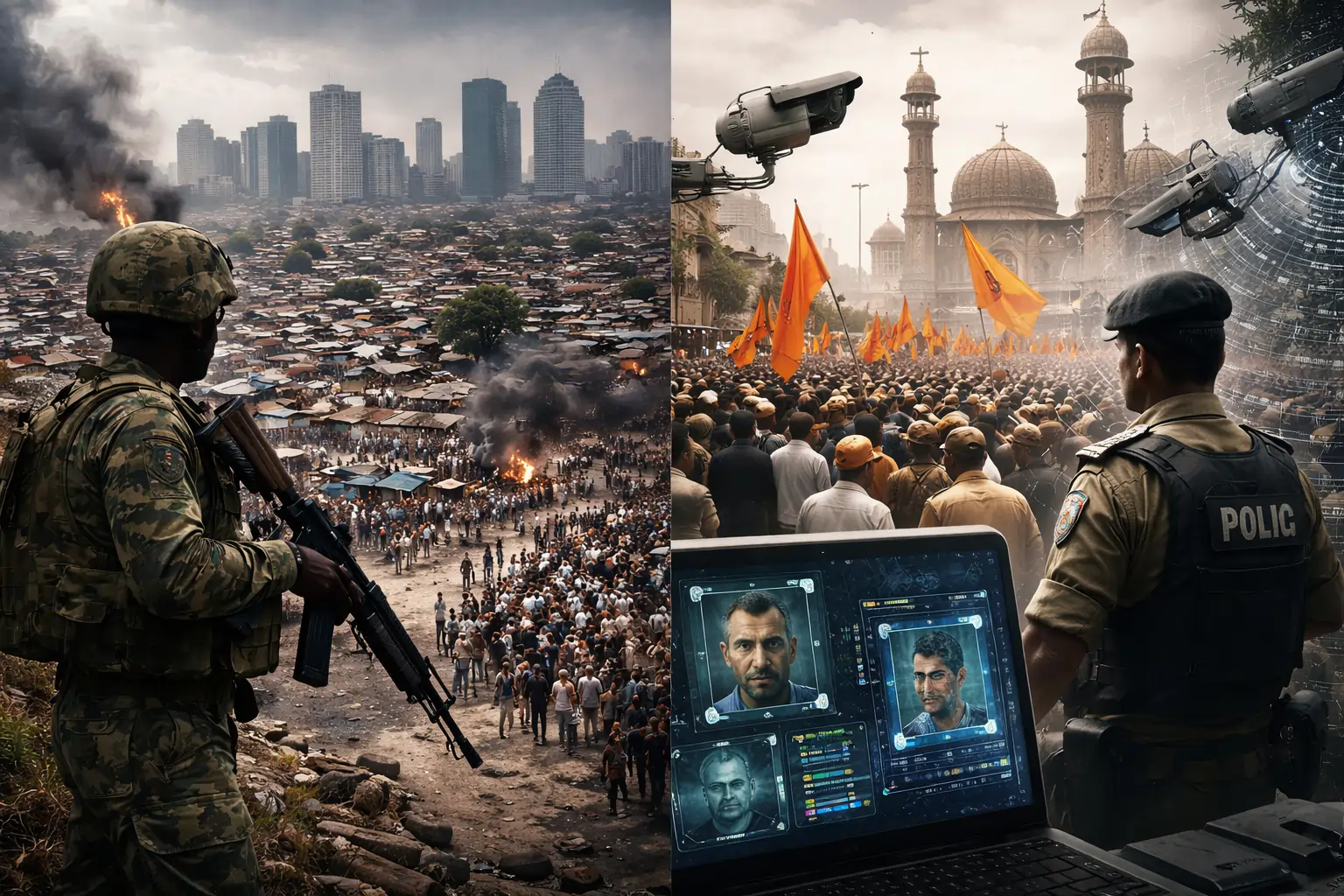
India is often promoted in the international geopolitical arena as the “Mirror to China” or the “Next Frontier of Capital.” On the other hand, post-colonial struggle is frequently used to describe Nigeria. But beneath these disparate reputations is a structural reality that is frighteningly similar. Currently, both countries are conducting a high-stakes political experiment in which extreme economic inequality is being managed rather than resolved through the use of identity and state power.
It is a comparison of mechanical dysfunction rather than cultural similarity. India is a “strong state” that uses its administrative efficiency to institutionalize the same pathologies, religious mobilization, elite predation, and the like, while Nigeria is a “weak state” that is fighting to keep its pieces together.
The Demographic Time Bomb
Nigeria and India will be the world’s demographic anchors by 2050. With 400 million people, Nigeria is expected to become the second-largest democracy in the world, while India is expected to have 1.67 billion people. Both countries are currently relying on a “demographic dividend,” but neither is offering the material security necessary to maintain it.
The youth unemployment rate in Nigeria is a disastrous 33%. India’s GDP growth is “K-shaped”, that is, it benefits a small elite while the masses stagnate, despite the fact that the numbers appear strong on paper. The top 1% of Indians currently own more than 40% of the country’s wealth, according to recent data from the World Inequality Lab. This concentration is more extreme than it was at the height of British colonial rule. When a state cannot provide jobs, it provides “enemies.”
Identity as a Moral Economy
Religion has been used as a weapon in both societies to fill the gap left by an ineffective welfare state. In Nigeria, Islam and Christianity serve as “moral economies,” providing a sense of dignity and belonging that the government is unable to offer. There, political elites have long mastered “instrumentalized instability,” using religious conflict as a diversion from the reality that a small kleptocracy is embezzling oil rents.
India has used the “steroids” of state capacity to industrialize this Nigerian model. Hindu majoritarianism, or Hindutva, is the foundation of the contemporary Indian state and not just a social movement. Economic complaints, such as hunger, agricultural hardship, and long-term unemployment, are routinely transformed into societal fears.
India’s religious conflicts are procedural, whereas Nigeria’s are frequently chaotic and reactive. Majoritarian violence is not only tolerated by the state, but it is also institutionalized through policy. The marginalization of 200 million Muslims is viewed as an administrative necessity for “national renewal,” from the Citizenship Amendment Act (CAA) to “Bulldozer Justice,” which circumvents the legal system to demolish minority homes.
The Digital Panopticon: Chaos vs. Capacity
The most unsettling distinction between the two countries is their competence rather than their objectives. Nigeria’s shortcomings are evident because the government is frequently unable to conceal them. It struggles to maintain a monopoly on violence in its northern territories and has a tax-to-GDP ratio of about 10%.
In contrast, India is a state with a large capacity. It has a top-notch security system, a national digital infrastructure, and a well-organized bureaucracy. This makes repression “legalized” as opposed to arbitrary.
- The Surveillance State: With almost 46% of all internet shutdowns worldwide in 2023, India leads the world in this regard.
- The Digital Leash: The “India Stack” and Aadhaar have been used as weapons for “anticipatory compliance.” The government may use a baton in Nigeria; in India, it may use a phone infected with Pegasus or a frozen bank account.
India’s functionality amplifies its effects, while Nigeria’s dysfunction restricts its reach. A state that has the capacity to monitor, punish, and imprison large numbers of people can create a terrifying “authoritarian stability” in the face of widespread hardship.
The Normalization of Cruelty
In both nations, poverty is being moralized. It is no longer treated as a policy failure but as a deficiency of the individual, a lack of discipline or “nationalist fervor.”
India is ranked 105th out of 127 countries in the 2024 Global Hunger Index, falling behind several sub-Saharan African countries, despite building magnificent motorways and hosting G20 summits. This is what defines “extraction wrapped in symbolism.” Nutrition is replaced with national pride. Corporate capital concentration reaches previously unheard-of heights while sacrifice for the “greater civilizational project” is exalted.
In a similar way, violence has also been “outsourced.” Local militias in Nigeria take the place of the police. Cow-protection squads and “vigilante groups” serve as an unofficial extension of state power in India, punishing dissidents and minorities without the bureaucratic red tape of a courtroom.
A Fragile Coherence
The trajectory of these two nations suggests a disturbing new model for the 21st century: the “High-Capacity Illiberal State.”
India is not a success story that Nigeria is failing to emulate. Rather, India is demonstrating a more sophisticated way to fail. It is showing how a state can maintain the facade of a “vibrant democracy” while hollowed-out institutions and weaponized technology ensure that power remains centralized and dissent remains dangerous.
History is unforgiving to regimes that confuse coercion with strength. You can manufacture consent through media control and suppress dissent through digital surveillance, but material reality, hunger, inequality, and unemployment, eventually returns. Whether through the chaotic breakdown seen in parts of Africa or the calibrated repression seen in South Asia, the result is the same: a state that governs against its own people.
The warning is clear: No society can indefinitely survive by substituting identity for justice. When the steroids of state capacity eventually wear off, the underlying systemic collapse is all that remains.









Leave a comment