





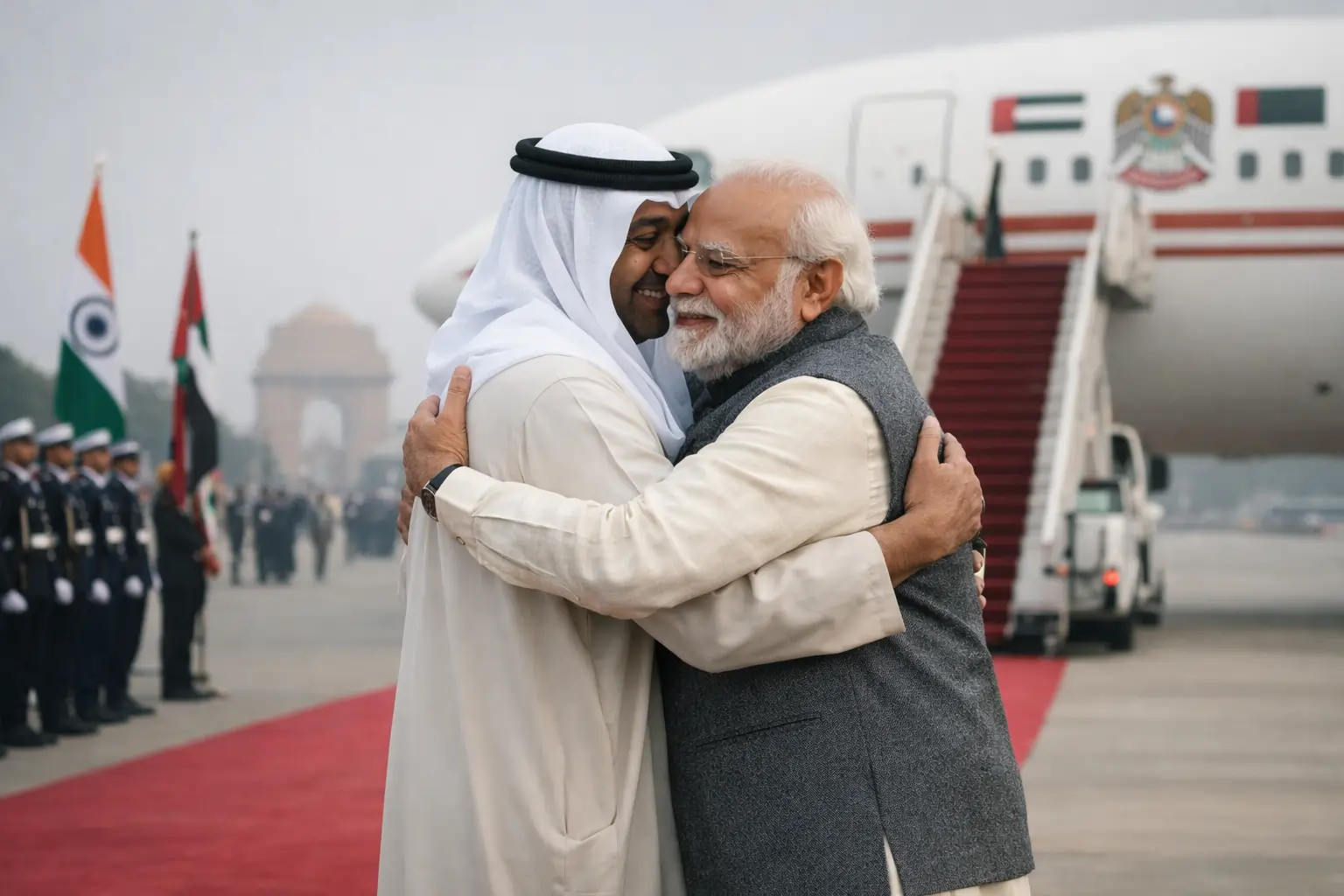
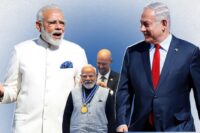
The winter air in New Delhi carried a distinct diplomatic weight this afternoon as His Highness Sheikh Mohamed bin Zayed Al Nahyan (MBZ), President of the United Arab Emirates, touched down for a high-stakes official visit. In a gesture reserved only for the closest of partners, Prime Minister Narendra Modi personally received the UAE President at the airport, welcoming him with a warm embrace that has become a hallmark of their “brotherly” bond. “Went to the airport to welcome my brother… His visit illustrates the importance he attaches to a strong India-UAE friendship,” PM Modi shared on X, signaling to the world that the relationship has moved far beyond traditional trade into the realm of a Comprehensive Strategic Partnership.
However, beneath the optics of the red-carpet welcome and the $100 billion trade milestone, a more complex geopolitical narrative is unfolding. Recent reports suggesting that the UAE President has declined to sign a specific defense pact aimed at countering regional neighbors specifically Pakistan and Saudi Arabia have sparked intense discussion among strategic analysts.
No Deal only LOI: India- UAE Defence Decline!
Given the diplomatic nature of the visit, including high-profile receptions and “brotherly” speeches, the substantive outcome in the defense sector was a non-binding Letter of Intent (LOI). However, given the LOI nature of the Agreement, the UAE maintained its position and signaled a refusal to enter a legally binding defense treaty (with an alliance upon a military) that would be perceived as a strategically hostile act to its immediate neighbors: Pakistan and Saudi Arabia.
This reflects a “pragmatic” form of hedging. Abu Dhabi retained its warm relationship with New Delhi and avoided the defense integration, operational cross-technology transfer, and mutual defense commitment a “deal” would require. The UAE’s most central security derives from the West’s highly sophisticated military technology, and thus the India-UAE defense relationship remains a “treaty” of the symbolic partnership of intent, lacking any substantive change in the military capabilities of the region.
A Partnership Built on Multi-Alignment
For many years, the India-UAE relationship was defined by oil and the massive Indian diaspora. Today, it is a multifaceted engine of growth.
- Economic Integration: Bilateral trade has surpassed $100 billion, bolstered by the landmark Comprehensive Economic Partnership Agreement (CEPA).
- Energy Security: Just today, a long-term deal was finalized for the annual supply of 0.5 million tons of LNG to India, ensuring the nation’s energy future.
- The Diaspora Link: Over 4.3 million Indians call the UAE home, acting as a living bridge between the two nations.
Despite this unbreakable bond, the UAE operates within a delicate framework of strategic autonomy. Abu Dhabi has consistently championed a policy of “zero problems with neighbors” and de-escalation, even as it deepens ties with New Delhi.
The Defense Dilemma: Why the Refusal Matters
The rumors surrounding a refused defense pact must be viewed through the lens of recent shifts in Middle Eastern security. In late 2025, Pakistan and Saudi Arabia signed a historic defense agreement, which reportedly includes a “mutual defense” clause.
While New Delhi has expressed sensitivities regarding the Saudi-Pakistan pact, the UAE appears hesitant to join any formal military alliance that could be perceived as “taking sides” or creating a block against other regional powers.
The UAE’s strategic calculus likely involves three key factors:
- Maintaining Neutrality: Unlike a traditional military alliance, the India-UAE defense relationship focuses on interoperability, joint exercises (like Desert Cyclone-II), and industry collaboration, rather than mutual defense obligations.
- Tensions with Riyadh: While there have been simmering disagreements between the UAE and Saudi Arabia over Yemen and oil production, the UAE is unlikely to use its relationship with India as a “weapon” against its GCC neighbor.
- The Pakistan Factor: Despite cooling relations at times, Pakistan remains a significant regional player for the UAE. Abu Dhabi prefers a role as a mediator and stabilizer rather than a participant in South Asian rivalries.
This emphasis on flexibility and strategic autonomy is not limited to India’s engagement with the Gulf. New Delhi has demonstrated a similar approach in its global energy diplomacy, calibrating economic interests without locking itself into rigid geopolitical blocs. Notably, Poland’s Foreign Minister Radosław Sikorski recently praised India—on two separate occasions—for reducing its dependence on Russian crude oil, a move that has been closely watched and positively received in European policy circles as well. Read More
Navigating the “West Asia Churn”
The timing of the visit could be a cause for concern. With the US and Iran in an arms race, and a ceasefire in Gaza, there is growing instability in the region. Both India and the UAE are aiming for an absence of direct military engagement in the region.
“India and the UAE maintain a high level of convergence across various regional issues, each with their own distinct red lines when it comes to formal military ties.” — Strategic Analyst Observation.
By concentrating on food security, technology, and energy, MBZ and Modi are creating a partnership that is future-proof from military alliances and their transient nature. The decision not to enter into a formal defense pact with one another against select adversaries is not a sign of weakness in the India-UAE relationship. It is, rather, a sophisticated masterclass in multi-alignment.
The Road Ahead
Sheikh Mohamed bin Zayed’s visit, though short, reaffirms that India remains a key component of the UAE’s Look East strategy. While the headlines focus on the lack of signed agreements, the truth is that the relationship is more advanced and more differentiated than ever before. The partnership is, literally, being constructed across the expanse of The BAPS Hindu Mandir in Abu Dhabi and the LNG terminals in India. It is not merely being written on paper.







Leave a comment