






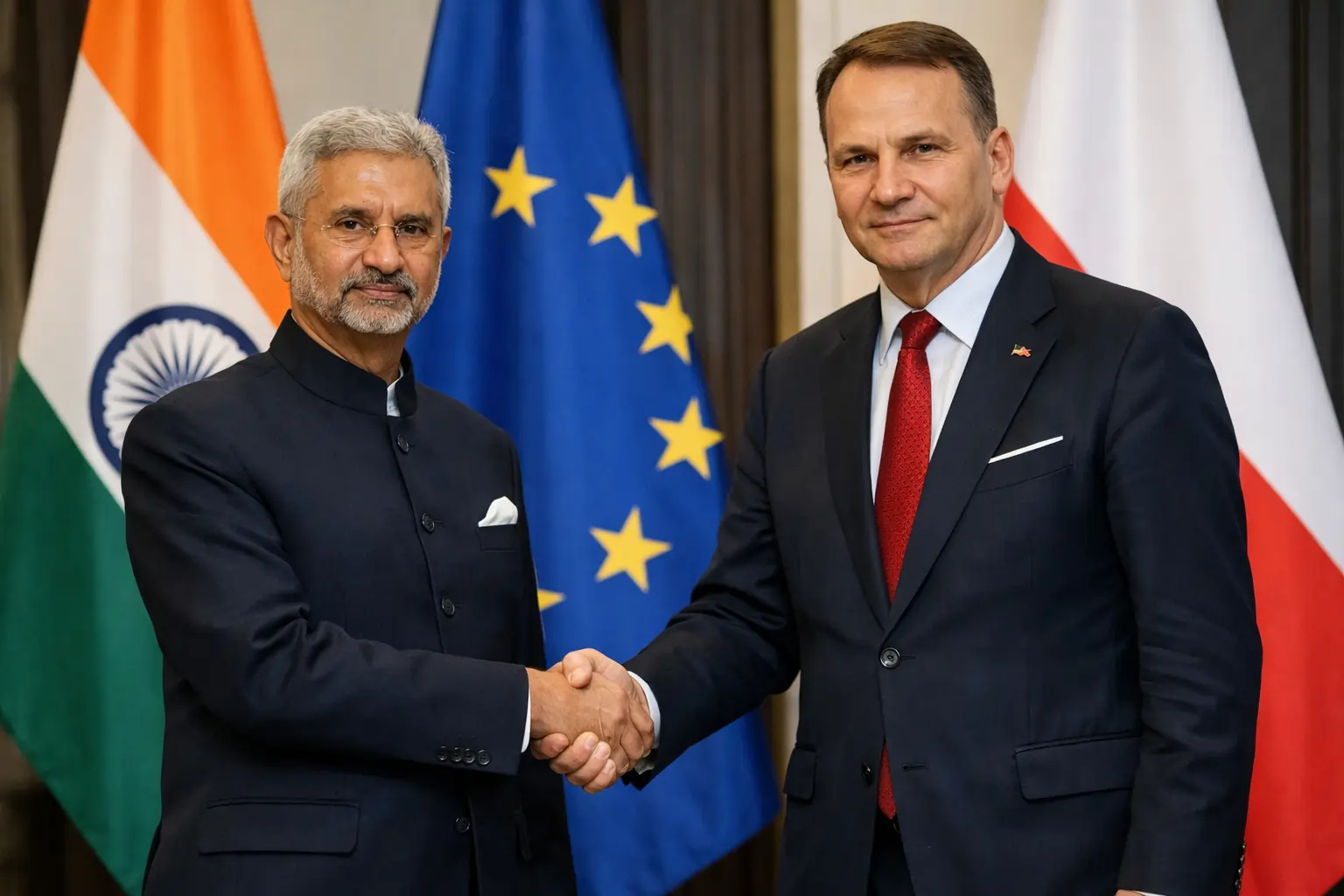
New Delhi – Polish Foreign Minister Radosław Sikorski has publicly commended India’s reduction in Russian oil imports on two separate occasions within a fortnight, first during the India-Weimar Triangle meeting in Paris and again during his official visit to New Delhi from January 17-19, 2026.
Standing alongside External Affairs Minister S. Jaishankar at the inaugural India- Weimar Triangle foreign ministers’ meeting in Paris on January 7, 2026, Sikorski stated,
“I expressed my satisfaction that India has reduced Russian oil imports because this is fueling Putin’s war machine,”
According to statements reported by Sunday Guardian Live.
Sikorski repeated the message during his three-day visit to India, telling audiences,
“We hope that India wants to contribute to a fair ending of the Russian aggression against Ukraine.”
The Polish minister’s statements come as India’s Russian crude imports dropped to 1.2 million barrels per day in December 2025, marking a three-year low, according to data from maritime intelligence firm Kpler cited by Business Standard on January 18, 2026. The figure represents a decline from 1.84 million barrels per day in November 2025.
India’s Russian oil imports averaged 1.18 million barrels per day in the first half of January 2026 and are expected to remain capped at around 1.4 million barrels per day, as against the average import of 1.7 million barrels per day in 2025, according to Kpler data reported by Business Standard.
The reduction follows sustained pressure from the United States and Europe. US President Donald Trump imposed a 25 percent tariff on Indian goods in August 2025, later doubling it to 50 percent, citing India’s purchase of Russian oil as indirectly supporting President Vladimir Putin’s war effort. The Trump administration imposed sanctions on Russia’s two largest oil producers, Rosneft and Lukoil, effective November 21, 2025.
Major Indian refiners responded by scaling back purchases. Reliance Industries, India’s largest buyer of Russian oil, slashed purchases by almost 50 percent in December, according to the Centre for Research on Energy and Clean Air, reported by Business Standard. Mangalore Refinery and Petrochemicals did not purchase any Russian barrels for the first time since September 2022, according to The Moscow Times on January 5, 2026.
Data from the Centre for Research on Energy and Clean Air shows India’s daily purchases of Russian oil fell to 72.9 million euros in early January 2026, down from 130.5 million euros in late November and 189 million euros in July 2023, as reported by Sunday Guardian Live.
Sikorski acknowledged India’s historical reliance on Russia during his remarks. Speaking at the Jaipur Literature Festival on January 18, 2026, he noted that Russia is now selling oil at cheaper prices and becoming increasingly dependent on China, according to The Tribune.
The Polish Foreign Minister arrived in New Delhi on January 19, 2026, after attending the Jaipur Literature Festival from January 17-18. He met External Affairs Minister S. Jaishankar to discuss the India-Poland Strategic Partnership. MEA Spokesperson Randhir Jaiswal stated, “His engagements in New Delhi are focused on furthering the India-Poland Strategic Partnership,” as reported by New Kerala.
India remains one of Russia’s largest oil buyers despite the reduction. Since the Ukraine war began in 2022, India has imported approximately 144 billion euros worth of Russian crude, according to Sunday Guardian Live. In 2021, prior to Russia’s invasion of Ukraine, Russian oil constituted around 2.5 percent of India’s total oil imports, according to the US Energy Information Administration cited by Al Jazeera. Sumit Ritolia, lead research analyst at Kpler, told Business Standard on January 18, 2026, “As long as broader secondary sanctions are not enforced, India is expected to continue importing Russian barrels as economics support the case. These barrels are likely to remain structurally embedded in India’s crude slate, albeit increasingly through indirect and less transparent channels.”
Indian refiners are diversifying their procurement, with increased purchases from Saudi Arabia, Iraq, and the US. India imported about 954,000 barrels per day of crude from Saudi Arabia in the first half of January 2026, up from 699,000 barrels per day in December 2025, according to Business Standard.
The European Union’s 18th sanctions package, adopted in July 2025, banned imports of refined oil products derived from Russian crude from January 21, 2026, according to the Center for Strategic and International Studies.












Leave a comment