








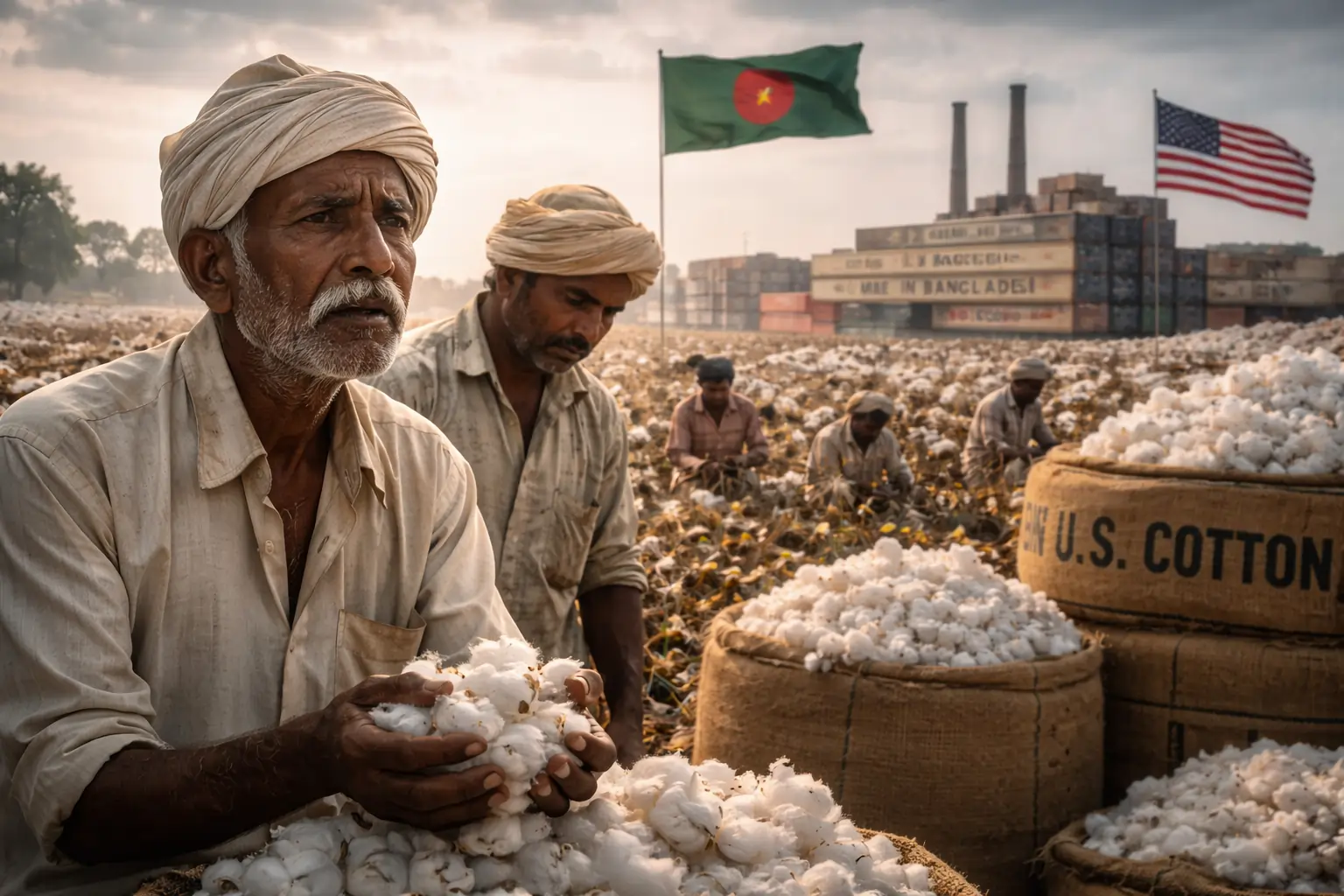
The February 6, 2026 trade deal between India and the United States doesn’t just reduce tariffs-it threatens to dismantle the economic foundation of millions of Indian cotton farmers while handing Bangladesh a strategic advantage in the global textile market. As Commerce Minister Piyush Goyal celebrated opening access to a “$30 trillion market,” he conveniently ignored what Congress General Secretary Randeep Singh Surjewala laid bare: “We are already importing $334 million worth of cotton from the US, which has caused cotton prices for Indian farmers to crash. Now, with corn, cotton, sorghum, fruits, processed fruits, and soybeans coming from the US, I ask PM Modi and Piyush Goyal: what will happen to India’s farmers?”
The answer is already visible in mandis across Punjab, Gujarat, and Maharashtra-unsold stocks, collapsing prices, and deepening indebtedness. Meanwhile, Bangladesh, which imports cotton rather than grows it, will leverage the same US supply glut to secure cheaper raw materials without triggering domestic agricultural collapse. This isn’t just trade policy asymmetry. It’s structural violence against Indian farmers disguised as economic liberalization.
India’s Cotton Economy: When Demand Floor Collapses
India is among the world’s largest cotton producers, with FAS Mumbai estimating 2025/26 production at 24.5 million 480-pound bales from 11.2 million hectares. Cotton cultivation spans Gujarat, Maharashtra, Telangana, Karnataka, Punjab, Haryana, and Rajasthan- states where millions of smallholder farmers depend on Minimum Support Price mechanisms and assured procurement cycles. For 2025-26, the government raised cotton MSP by 11.84% -7,710 per quintal for medium staple and 8,110 for long staple-the third-highest absolute increase among all Kharif crops at ₹589 per quintal.
This MSP hike sounds impressive until you understand its purpose: protecting farmers from market volatility when global prices fall. According to the Commission for Agricultural Costs and Prices, MSP ensures a minimum 50% return over production costs. The Cotton Corporation of India procures cotton at MSP with no quantity limits, providing a guaranteed buyer when private mills refuse to pay fair prices. This procurement mechanism is the demand floor that stabilizes cotton prices across India’s agricultural belt.
But here’s the fatal flaw: MSP only works when domestic mills actually buy Indian cotton. If textile manufacturers begin large-scale substitution of imported fiber for local produce, that demand floor collapses. The US-India trade framework commits New Delhi to “eliminate or reduce tariffs on all U.S. industrial goods and wide-ranging agricultural and food products,” specifically including “distillers’ grains, tree nuts, soybean oil, fruits” according to the White House joint statement. While cotton isn’t explicitly listed, Surjewala’s February 7 warning from Panchkula makes clear that “US food and all agricultural products will enter India at 0% tariff,” including cotton.
The United States produces approximately 377.63 million tonnes of corn annually but also ranks among the world’s top cotton exporters with roughly 3 million bales exported in 2025-26. With zero or reduced tariffs, US cotton becomes price-competitive with domestic Indian fiber. Indian textile mills, facing their own cost pressures and export targets, will naturally gravitate toward cheaper imported cotton when available. The result: declining mandi arrivals, weaker MSP enforcement as procurement volumes drop, unsold stocks in farmers’ hands, and delayed payments from overwhelmed Cotton Corporation of India warehouses.
According to USDA data, India’s cotton production has already declined 2% from previous estimates as farmers shift to higher-return crops like paddy, pulses, and cereals. Kharif cotton sowing decreased 2.4% from last year as of August 1, 2025. An 8% MSP increase is “pushing fiber prices higher, encouraging mills to increase imports,” according to FAS Mumbai. This creates a vicious cycle: higher MSP makes Indian cotton less competitive, incentivizing imports, which further undermines domestic demand and collapses farmer incomes despite nominal MSP protections.
Bangladesh’s Structural Advantage: Import-Dependent Model
Bangladesh operates a fundamentally different textile paradigm. It is not a major cotton grower and already relies heavily on imported raw cotton to sustain its $50 billion export- driven readymade garment industry. According to multiple industry reports, Bangladesh sources cotton from the United States, India, and other major producers precisely because domestic cultivation is minimal. The country’s textile manufacturing value chain- spinning, weaving, dyeing, garment assembly-is structured around import dependence rather than farm linkages.
This creates an asymmetric outcome when US cotton tariffs drop. For Bangladesh, cheaper US cotton is simply input cost reduction-allowing mills to maintain margins while competing against Vietnamese, Chinese, and Indian garment exporters in global markets. There’s no domestic cotton-farming constituency to protect, no MSP mechanism to defend, no rural agricultural crisis triggered by declining domestic demand. As the US- Bangladesh reciprocal trade agreement signed February 9 demonstrates, Dhaka secured zero-duty access to the US market for garments made using American cotton-a provision that incentivizes Bangladesh to source from America while Indian textile exporters face 18% tariffs without comparable exemptions.
The numbers expose India’s disadvantage. The US-Bangladesh deal includes Bangladesh’s commitment to purchase $3.5 billion in US agricultural products over 15 years-including cotton. Yet Bangladesh faces only 19% tariffs on most exports versus India’s 18%, and gets zero-duty treatment for textiles using American cotton. Indian cotton farmers watch as their own government opens domestic markets to US fiber, Indian textile mills shift to imported cotton to cut costs and compete with zero-duty Bangladeshi garments, and India’s Cotton Corporation struggles to procure domestic production at MSP as mill demand evaporates.
The MSP Illusion: Protection Without Procurement
Surjewala’s critique cuts deeper than tariff rates. On February 7, he described the framework’s call for removal of “non-tariff barriers” as eliminating subsidies to Indian farmers: “Indian farmers already struggle, as their production costs are higher than the prices they receive. Now, you have agreed in writing to remove even those subsidies. A bigger blow than this cannot be dealt to India’s 720 million farmers.” According to the US- India agreement, India must “address longstanding non-tariff barriers on imports of agricultural products, medical devices, and communications gear, with negotiations to be completed within six months on accepting US or international safety and licensing standards.”
These “non-tariff barriers” include phytosanitary standards, quality specifications, and import licensing-mechanisms that previously restricted US agricultural product entry to protect domestic farmers. Removing them means American cotton, corn, sorghum, soybeans, and other crops will flood Indian markets with minimal regulatory obstacles. Goyal’s assurance that the agreement “safeguards farmers’ interests and rural livelihoods by completely protecting sensitive agricultural and dairy products” rings hollow when the framework explicitly commits to eliminating barriers and reducing tariffs on US agricultural goods.
The MSP mechanism itself becomes a fiction when procurement collapses. According to government data, cotton procurement through CCI has been declining as private mills dominate purchasing. During 2014-15 to 2024-25, MSP payments to all Kharif crop farmers totaled 16.35 lakh crore-but cotton’s share remains modest compared to paddy and wheat which enjoy guaranteed procurement through FCI and state agencies. Cotton farmers must compete in mandis where private mills dictate terms, and if those mills prefer cheaper US imports, the MSP becomes a paper price with no actual buyer.
Why Bangladesh Wins While India Loses
The contrast between India and Bangladesh exposes the Modi government’s strategic failure. Bangladesh negotiated a trade deal that secures zero-duty access for textiles using American cotton-incentivizing US cotton imports while gaining preferential market access. India negotiated a deal that opens domestic markets to US cotton without securing comparable advantages for Indian textile exports, which still face 18% tariffs with no zero- duty exemptions for using any specific cotton source.
Bangladesh commits to purchasing $3.5 billion in US agricultural products over 15 years, including cotton. But Bangladesh has no domestic cotton farming lobby to oppose this because it already imports all cotton. The $3.5 billion commitment is simply formalizing existing trade flows while extracting zero-duty concessions. India commits to $500 billion in US goods over five years-including agricultural products-while simultaneously having a massive domestic cotton farming sector that will be devastated by those very agricultural imports. India gets the worst of both worlds: opening its markets to imports that harm farmers, without securing the kind of preferential export treatment Bangladesh achieved.
As Mallikarjun Kharge stated regarding the Bangladesh deal, “By granting Dhaka zero- duty access for using American cotton, Washington has effectively incentivized Bangladesh over Indian farmers.” The same logic applies to India’s own deal: by eliminating tariffs on US cotton without securing zero-duty export status for Indian textiles using Indian cotton, Modi’s government has incentivized Indian mills to abandon domestic farmers in favor of American imports while giving Bangladesh better US market access than India achieved.
The asymmetry is staggering. Bangladesh textile hubs gain cheaper raw materials without rural economic fallout. Indian cotton farmers face collapsing demand as mills shift to imports, undermining MSP protections and deepening agrarian crisis. Indian textile exporters face 18% US tariffs while competing against Bangladeshi garments entering America duty-free. Modi celebrates this as opening “$30 trillion market access” while opposition leaders call it “sacrificing the interests of farmers and agricultural landowners.”
Structural Violence as Trade Policy
The US-India trade deal’s cotton provisions aren’t just bad economics-they’re structural violence against India’s agricultural communities. Millions of smallholder farmers in Gujarat, Maharashtra, Telangana, Punjab, and other cotton-growing states depend on domestic demand to sustain MSP mechanisms. When textile mills substitute US imports for local cotton, that demand floor collapses, triggering price volatility, unsold stocks, weakened MSP enforcement, and rising farm distress in regions already experiencing cyclical agrarian crises.











Leave a comment