








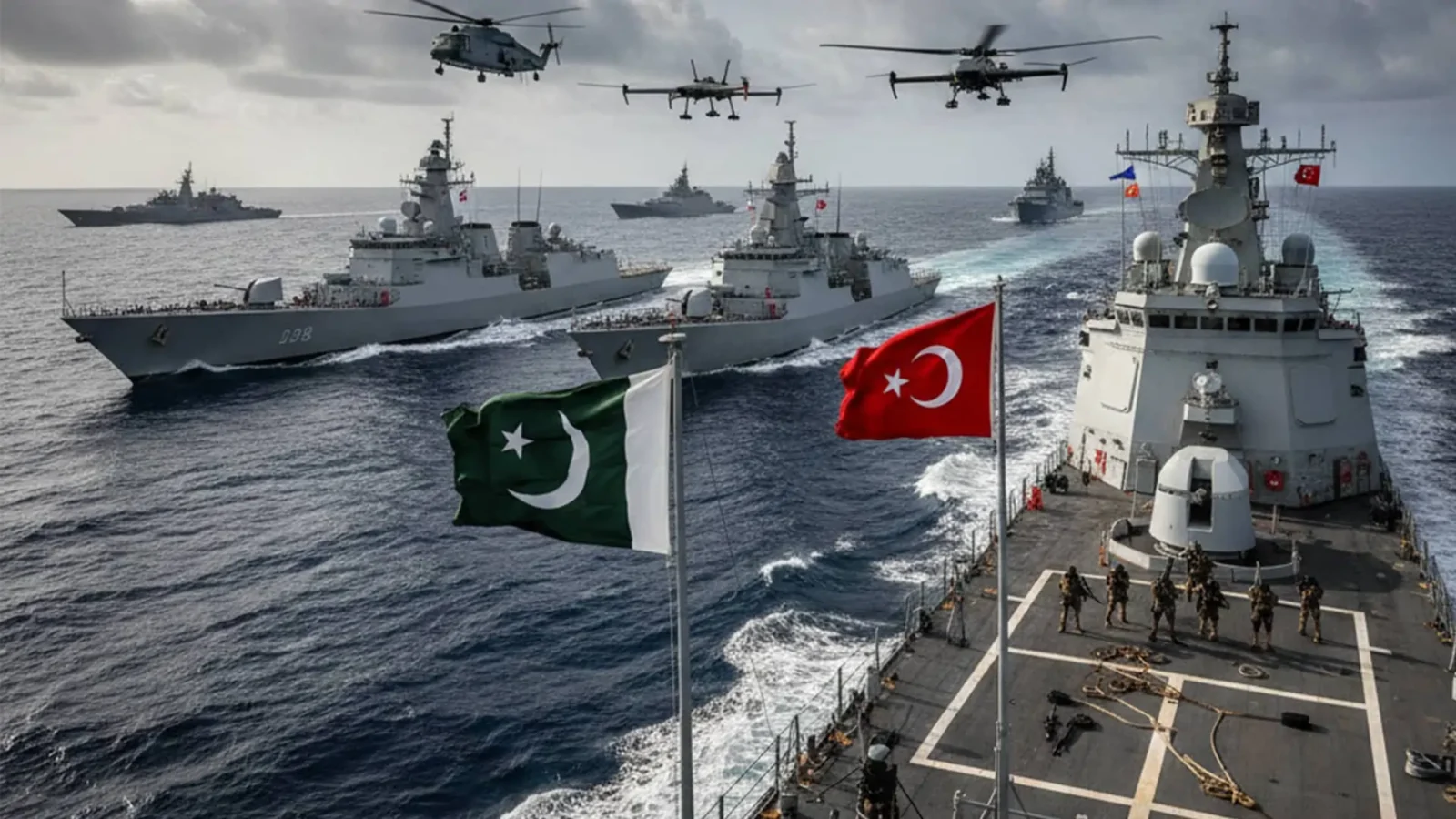
From December 15 to December 26 2025, elite navy units from Pakistan and Türkiye carried out Exercise AYYILDIZ 2025, highlighting their strengthening strategic relations and operational synchronization. This 12- day intense exercise brought together the Pakistan Navy Special Service Group (SSG-N) and Türkiye’s Su Altı Taarruz (SAT) commandos at the Turkish Naval Special Operations Command base in Istanbul.
The exercise was pivotal in Islamabad and Ankara’s emerging bilateral defense ties. Both partners have been successfully integrating their maritime doctrines to respond to evolving concurrent security challenges. While the official comments from these partners spoke to the aims of the exercise being counter-terrorism and regional stability, the sophistication and scope of the exercise suggests a growing and enduring relationship that can potentially influence power dynamics in the North Arabian Sea and Eastern Mediterranean.
Tactical Objectives and Interoperability
Impressions from the operations conducted during AYYILDIZ 2025 suggest that extensive planning went into the tasks of counter- unconventional warfare and maritime specialized operations. A major consideration remained on the interoperability of the two separate military units to operate as one cohesive military whole. This was achieved via the operationalization of adaptive mixed assault teams and the collaborative use of new tactical frameworks.
Main objectives of the exercises were:
- Anti-Submarine Warfare (ASW): Tracking and countering quiet underwater threats using sonar and advanced detection methods.
- Visits, Boards, Searches, and Seizures (VBSS): Interdiction of illegal sea operations using speed boats and helicopter drills.
- Frogman & Sniper Operations: Underwater stealth movements and maritime platform precision shooting.
- Counter Terrorism: Operations involving hostage rescue and other actions in contested sea close support environments.
Learning from Experience: The Pakistan-Türkiye Exchange
AYYILDIZ series has a distinctive feature of reciprocal exchange of combat experience. On one hand, Pakistan’s SSG(N) has decades of expertise from operational deployments in counter-insurgency and anti-piracy operations in the Indian Ocean. On the other hand, Türkiye’s SAT commandos are seasoned in advanced operations in the Mediterranean and NATO-integrated warfare.
Analysts argue that Türkiye has the most to gain from Pakistan’s combat experience as it pertains to non-state actors and the maritime smuggling rings. On the other hand, Pakistan is benefitting from Türkiye’s developed defence industry, particularly in the areas of drone technology and modern warship (naval platforms) construction.
A Noteworthy Year for Defense Diplomacy
The signing of AYYILDIZ 2025 comes on the heels of another record-breaking year in the Pak-Turk defense saga. Only days before the exercise, the Istanbul Naval Shipyard commissioned the second MILGEM-class ship, the PNS Khaibar. These warships, which boast the latest in sensor and weapon suite technology, stand as a monument to the joint production potential of both countries.
Additionally, 2025 has witnessed the most advanced discussions regarding the Pakistan assembly of Turkish combat drones and the possible invitations to Pakistan to join the KAAN fifth-generation fighter jet program. Collectively, these instances indicate that the “Bilateral” relationship is beginning to mature beyond mere military exercises into a substantial industrial and technological partnership.
The Drone Factor and Technological Synergy
Perhaps the most important hallmark of 2025 is the application of autonomous systems in traditional maritime warfare. During AYYILDIZ, both navies tested the coordination of unmanned systems, and specifically, the Turkish constructed ULAQ armed unmanned surface vessels (USVs) in conjunction with the Pakistan special boarding forces.There is evidence of this technological advance in the air as well. After the conclusion of two dozen major deals in early 2025, the YIHA kamikaze drone development collaboration was announced. While regional partners are describing these drone deals as counter-terrorism partnerships, in addition to the YIHA collaborating to develop ultra cheap, yet highly lethal kamikaze drones, YIHA drons are describing the ability to penetrate and swarm as a tactic that overwhelms and defeats traditional naval countermeasures/defenses. This is particularly relevant in the Aegean and Arabian seas, amongst the already cramped and contested maritime environments.
Operational Backbone: Jinnah-Class and MILGEM
The most prominent example of this collaboration is the MILGEM program. With the 2025 PNS Khaibar commissioning, the Pakistan Navy has now entered a new era of surface warfare. These vessels are not simply off the shelf “buy and sell” transactions. They are a result of a substantive technology transfer (ToT) arrangement, enabling Pakistan to construct Jinnah-class frigates in country.
- Pakistan now has the ability to extend its power projection beyond its immediate coastline with the addition of these vessels. They possess an operational range of 3,500 nautical miles.
- Modern Weapons: Even while corvettes are constructed with relatively cheap materials, vertical launch systems (VLS) for air defense and new generations of anti-ship missiles make them a truly formidable blue-water threat.
Geostrategy and Regional Deterrence
The exercises are described as defensive, with a focus on saving ‘good order’ at sea, but the description also alludes to the geopolitical dimensions of the exercise. Turkey and Pakistan both have unique maritime rivalries of their own: Turkey’s in the contested and energy-rich Eastern Mediterranean, and Pakistan’s in the critically important Arabian Sea.
Turkey and Pakistan are also sending joint tactical AYYILDIZ and massive wargames signals of tactical joint superiority. The Conduct of such untraditional wargames also serves as a credible deterrent to their direct adversaries. For both of them, the central aim remains the protection of sovereign maritime interests and the equilibrium of power in their theatres of influence.
“Professional experiences from these bilateral exercises are mutually strengthening and will lead to more cooperation between the two brotherly navies,” remarked the Pakistan Navy.
The Turkish Maritime Forces and AYYILDIZ 2025 participants will soon be heading home. As they prepare for AMAN 2026 multinational exercises, we understand that they will soon shift their focus to Turkish-led maritime exercises. The bridge between Istanbul and Karachi has further strengthened. It is no longer simply a diplomatic bridge, but a fortified maritime corridor based on shared technologies, tactics, and visions for the future.