







For decades, Indian governments sold migration as success. Software engineers in Silicon Valley, nurses in London, construction workers in Riyadh. Remittances grew. Headlines celebrated global Indian presence. What rarely entered public debate was fragility. In 2025, that fragility became visible and humiliating.
More than 24,600 Indians were deported from 81 countries in a single year. Thousands more remained stranded without legal status, income or protection. The Ministry of External Affairs admitted in Parliament that Indians were stuck overseas due to visa complications, particularly in the United States under tightening work visa rules. This was not an aberration. This was systemic failure catching up. India today has the world’s largest diaspora. It also has one of the weakest protection frameworks for its workers abroad.
A Global Workforce Built on Insecurity
As of December 2025, official data tabled by the Ministry of External Affairs placed the overseas Indian population at over 32 million, including 13.4 million NRIs actively working abroad. Independent estimates put the figure closer to 35 million. United States hosted nearly 5.7 million people of Indian origin. UAE and Saudi Arabia together hosted over 6.5 million Indian workers, mostly blue collar. Canada, UK, Malaysia followed close behind.
In FY 2024 to 25, remittances touched a record 135 billion dollars, according to the Reserve Bank of India. This accounted for over 3.4 percent of GDP, cushioning fiscal stress, supporting rural consumption, and stabilizing forex reserves. Yet the same workers generating this lifeline remained legally exposed, politically invisible, and diplomatically expendable.
Deportations 2025: Numbers India Cannot Ignore
In 2025 alone, 24,600 plus Indians were deported. This figure was confirmed in a written reply in the Rajya Sabha. Saudi Arabia accounted for nearly 11,000 deportations, driven by aggressive labor market nationalization under Vision 2030. UAE followed with over 1,400 cases, despite announcing visa amnesty schemes.
The United States deported approximately 3,800 Indians, a sharp increase compared to previous years. These removals were not limited to undocumented migrants. A significant number involved expired work visas, rejected renewals, and technical non compliance.
South East Asia added another disturbing dimension. Over 1,500 Indians were deported from Myanmar and 300 from Cambodia, many after being rescued from er scam compounds where they were trafficked under fake job offers.
Under the return of Donald Trump, immigration enforcement hardened rapidly for Indians. Work visas came under enhanced scrutiny. Indians were hit hardest because they made up nearly 72 percent of H1B holders, according to US Citizenship and Immigration Services data.
The Ministry of External Affairs spokesperson Randhir Jaiswal during the Ministry of External Affairs’ weekly press briefing on December 26, 2025 stated:
The mass cancellation of scheduled interviews of the H-1B visa applicants in view of the enhanced vetting measures has resulted in significant delays in their return to the U.S. Several people have been stranded for extended period, which has caused a lot of hardships to the families as well as their children’s education.
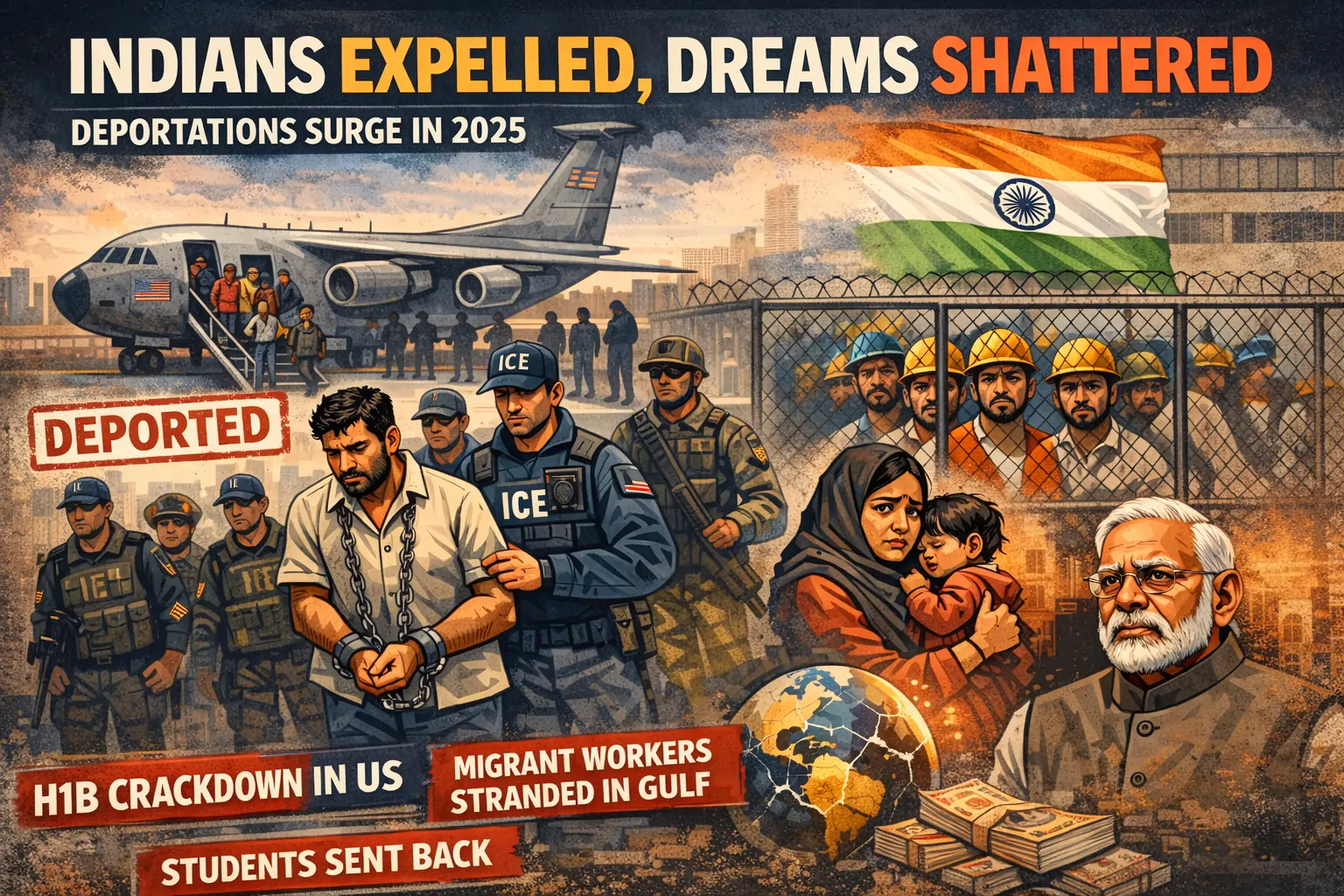
The deportations of Indians under Trump tenure were deeply symbolic. Indians handcuffed, put on chartered flights, paraded as enforcement success stories yet no serious diplomatic protest followed. On February 5, 2025, U.S. military plane landed in Amritsar with 104 deportees (including women), handcuffed and leg-chained for most or all of the ~40-hour flight. On February 15-16, 2025, Two more military flights brought ~229 deportees (117 +112) to Amritsar, with similar allegations of handcuffing and shackling during the journey. In October 2025, flight with ~54 deportees (mostly from Haryana) deported with same treatment.
Trump himself framed deportations bluntly.
“If you are not supposed to be here, you are going home. No exceptions.”
Statement at a campaign rally, Texas, March 2025.
India’s response remained procedural. No public defense of skilled workers who had contributed billions in taxes and innovation.
If the US story was about skilled insecurity, the Gulf story was about structural exploitation. Over 8 million Indians work in GCC countries, mostly under sponsorship systems that deny labour mobility. Absconding from an employer automatically converts a civil dispute into an immigration crime.
Saudi Arabia’s deportation drive in 2025 targeted overstays, undocumented workers, and those fleeing abusive employers. Indian missions facilitated travel documents. They did not question the system. The eMigrate portal flagged over 3,500 illegal recruitment agents in 2025. Despite this, fraudulent recruitment pipelines continued to operate openly in Indian states with high unemployment.
Former Foreign Secretary Kanwal Sibal warned bluntly.
“We export labor without exporting rights. That contradiction will keep humiliating us.” Interview with The Wire, August 2025.
Perhaps the most damning failure of cyber slavery was in South East Asia. Indians lured with promises of IT jobs were trafficked into scam centers in Myanmar and Cambodia. Passports confiscated. Beatings routine. Escape often meant arrest. MEA data confirmed a tenfold rise in such cases since2022. Advisories were issued. Yet recruitment agents continued advertising openly.
Another silent casualty was Indian students. In 2025, over 500 Indian students were deported across UK, Australia, Russia, and the US. Reasons ranged from exceeding work hour limits to failing enrolment compliance. Education consultants continue selling foreign degrees as migration pathways. Regulation remains weak. Students become collateral damage.
Times of India – Saudi Arabia leads GCC in Indian deportations
www.timesofindia.com/saudi-arabia-leads-gcc-in-indian-deportations
BJP’s Silence on Migrant Distress
The ruling Bharatiya Janata Party routinely celebrates diaspora success during overseas rallies. Prime Ministerial events abroad are stage managed showcases of Indian pride. Yet mass deportations, stranded families, and worker abuse rarely feature in domestic discourse. There has been no white paper on deportations. No parliamentary debate on H1B vulnerability. No labour rights framework for overseas Indians.
Former Finance Minister P Chidambaram remarked in a public lecture in Chennai.
“Remittances are welcomed. Migrants are not.”
September 2025.
That contradiction defines India’s migration policy today. India signs labor agreements, opens helplines, and issues advisories, but What it does not do is negotiate enforceable protections. Unlike Philippines or Mexico, India has never weaponized its labor supply diplomatically. Nor has it created domestic fallback mechanisms for returnees. MEA’s grievance portal MADAD handled thousands of cases in 2025 but resolution rates remain undisclosed. It is crucial for the Indian government to seek more favorable agreements with host countries to protect its nationals.
India likes to call itself a global workforce. In 2025, the world reminded India what that actually means. It means vulnerability, disposability, and humiliation without recourse. From H1B professionals in the United States to construction workers in the Gulf, Indians abroad discovered how thin the line is between opportunity and expulsion. The shame of deportation flights was not Trump’s alone. It belonged equally to a state that celebrates diaspora optics while neglecting diaspora rights. Unless India builds enforceable protection frameworks, regulates recruiters, negotiates labor dignity, and treats overseas Indians as citizens not cash flows, 2025 will not be an exception but a precedent.
This crisis unfolded amid rising regional rhetoric across South Asia, where India-Pakistan-Bangladesh tensions have sharpened nationalist posturing, shrinking diplomatic space and making migrant lives even more vulnerable abroad.
Source: https://indiadecode.in/rising-india-pakistan-bangladesh-rhetoric/