









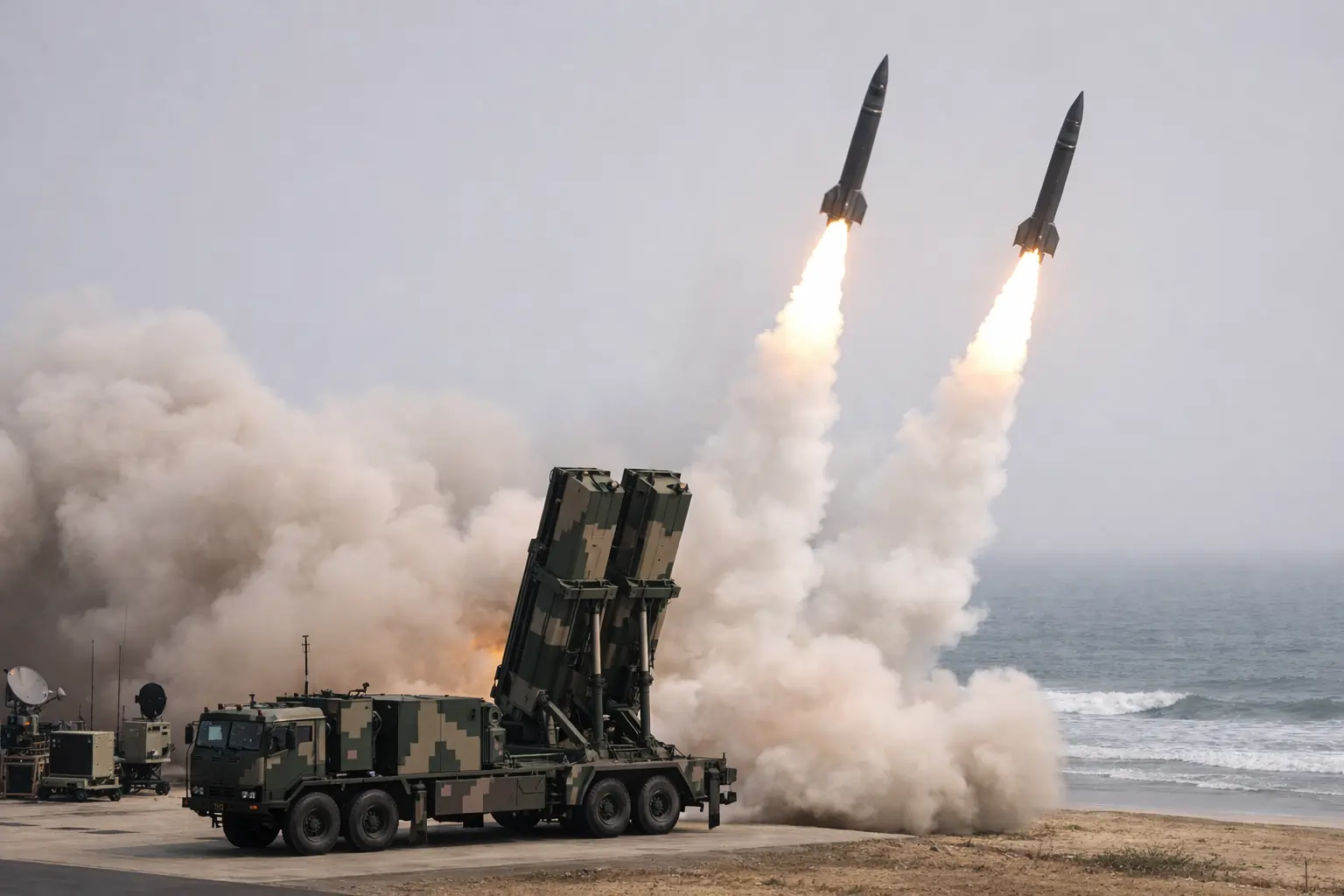
The Indian Ministry of Defense confirmed on 31 Dec 2025 the execution of a dual-missile salvo launch featuring the Pralay, an indigenously developed surface-to-surface short-range ballistic missile (SRBM). The flight tests were conducted by the Defence Research and Development Organization (DRDO) from a mobile platform located at the Integrated Test Range (ITR) off the coast of Odisha. This evaluation focused on the technical performance of the propulsion and guidance units when deployed in rapid succession from a single launcher.
The trials were monitored by the Indian Air Force (IAF) and the Indian Army, alongside DRDO scientists and production agencies. Data gathered from electro-optical tracking systems, radar stations, and telemetry assets confirmed that both airframes followed the pre-programmed ballistic arcs, achieving the specified terminal phase parameters.
Aerodynamic and Propulsion Architecture
The Pralay is technically classified as a quasi-ballistic missile, a hybrid design that deviates from the standard high-arc parabolic paths of traditional Short-Range Ballistic Missiles (SRBMs). During the terminal phase, the missile utilizes Jet Vane Control (JVC) and aerodynamic fins to perform high-G maneuvers. This unpredictability in the flight path is engineered specifically to defeat contemporary Anti-Ballistic Missile (ABM) systems, such as the HQ-9, by making the intercept point mathematically difficult to calculate for enemy radar.
The propulsion system consists of a single-stage solid-propellant motor utilizing a high-energy composite fuel. This choice of propellant provides a higher specific impulse compared to the older liquid-fueled Prithvi series, ensuring the missile can reach a hypersonic velocity during its terminal descent. The solid-fuel configuration also facilitates “canisterization,” allowing the missile to be stored for extended periods and launched with minimal preparation time.
Comparative Technical Analysis
To understand the Pralay’s role, it must be compared to existing regional systems such as the Chinese DF-12 (M20) and the Pakistani Ghaznavi (Hatf-III).
- Pralay (India): Features a range of 150–500 km with a payload capacity of up to 1,000 kg. It is distinguished by its quasi-ballistic maneuverability and is strictly intended for conventional warheads, aligning with tactical battlefield use.
- DF-12 / M20 (China): Possesses an advertised range of 280 km (export) to 400+ km (domestic). Like the Pralay, it is designed for precision strikes and utilizes GPS/INS guidance, often compared to the Russian Iskander-M.
- Ghaznavi (Pakistan): A more traditional SRBM based on the DF-11 design, with a range of approximately 290–300 km. Unlike the Pralay, which focuses on conventional precision, the Ghaznavi is a dual-capable system, able to deliver both conventional and nuclear payloads.
The Pralay’s integrated avionics suite includes a state-of-the-art navigation system that maintains a tight Circular Error Probable (CEP), ensuring that despite the maneuvers, the missile strikes within a few meters of the designated coordinates.
Integration into the Tactical ‘Rocket Force’
The Pralay is meant to address an identified gap within the regional theater, specifically between the Pinaka Multi Barrel Rocket Launchers (MBRL) and Agni series missiles. With the ability to perform precision strikes at 500 km, high value targets can be engaged without crossing the strategic/nuclear threshold, as the system affords a conventional strike capability.
Chandipur tracking sensors were able to record the missiles and their respective mid-course corrections. The partnerships for these testing phases with industry representatives indicates a movement to a more advanced stage, which the Indian Army calls the Mass Production and Induction phase (MPI). This phase aims to achieve a first-rate standard integration into the Indian Army’s artillery and missiles brigades. Read more
Operational Objectives: What These Missiles Are For
The Pralay system is designed to focus on high precision, conventional strikes against fixed and semi-mobile targets. The system’s tactical roles include:
- Suppression of Enemy Air Defenses (SEAD), where the system’s agility can be used for strikes on the associated radars and the Surface-to-Air Missile (SAM) batt
- Logistical Denial, The targeted destruction of the communication nodes, hardened command bunkers, and fuel storage structures.
- Counter-Battery Operations, the destruction of short-range missiles and heavy artillery of the enemy within the combat theater by the allied forces.
Concerns About the Stability of Regional Arms Proliferation
The Indian government has maintained that the Pralay has strictly defensive and deterrence purposes. However, the rapid proliferation of such systems makes the security dynamics of South Asia increasingly complex. Aspects of the Pralay program have drawn criticisms claiming such systems possessing quasi-ballistic technologies lowers the crisis “decision time” for other players in the region. In the absence of any consistent parameters that govern the trajectory of the Pralay, and given the potential consequences of the Pralay, there is a high likelihood that regional powers will have difficulties distinguishing/defining any given Pralay flight as a test, a strike, or an escalation.
The emphasis on “salvo” capability, which is specifically designed to defeat defensive perimeters, is a clear indication of more aggressive tactical doctrines that are on the horizon. Continuous proliferation of short-range ballistic missiles seems to be dictating an arms race in the region, as regional players are compelled to disproportionate increases in the numbers of missiles in their arsenals. Such aggressive militarization of the region increases the likelihood that a relatively minor border skirmish can be exacerbated dramatically, owing to the high speed and precision of the systems involved, and the overwhelming national resources that are diverted to such militarization.














Leave a comment