




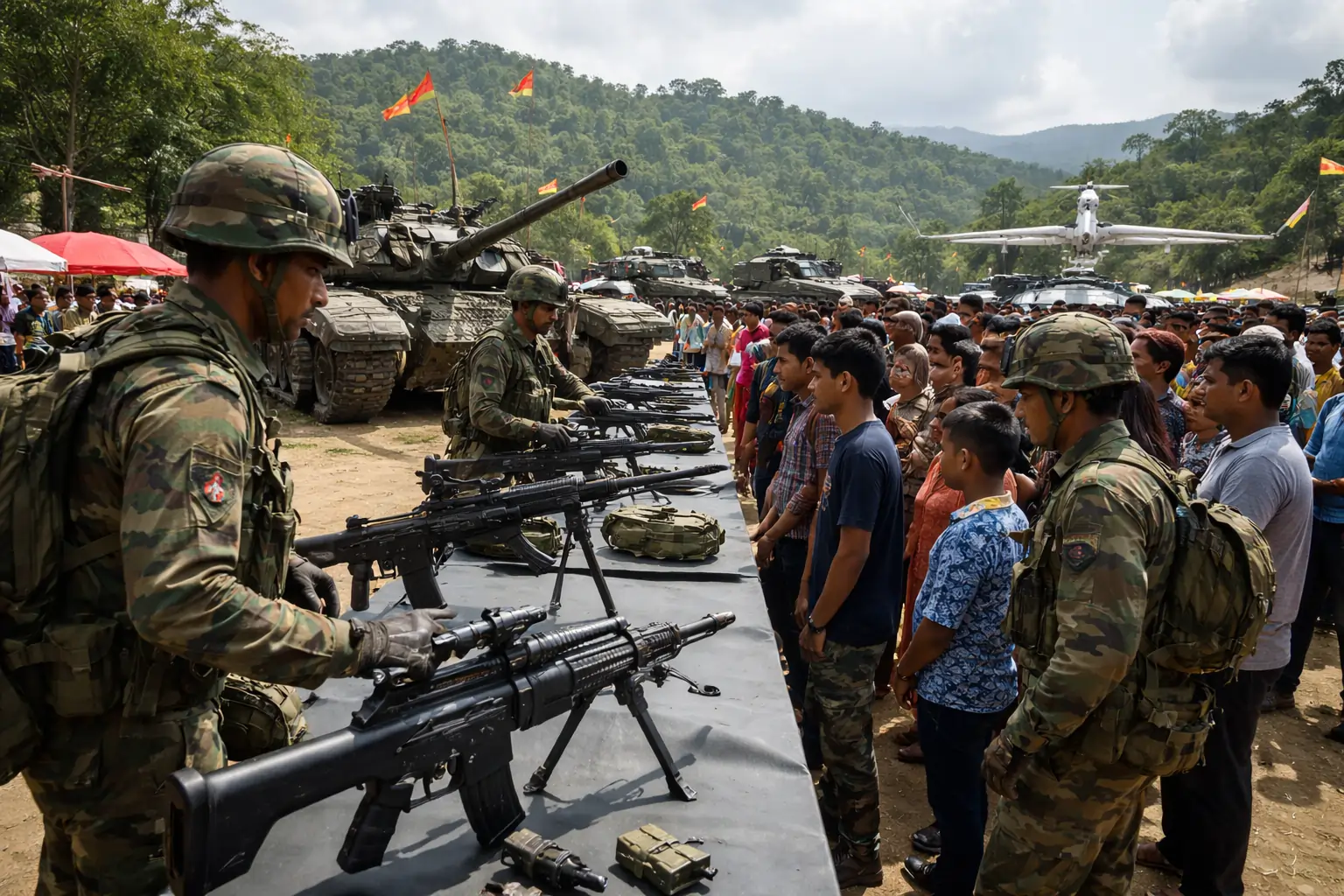
The Indian Army has recently increased the public display of its weapons systems and operational capabilities across several Northeastern states, using cultural and educational events as platforms to showcase military hardware in sensitive border regions. These activities, conducted in Arunachal Pradesh and Tripura, have drawn significant civilian participation and official endorsement, while raising questions about the messaging and long-term implications of heightened military visibility in areas marked by geopolitical tension and complex civil–security dynamics.
According to defense officials, the displays are part of a deliberate effort to project power and readiness. While framed as community outreach, the presence of advanced weaponry in civilian spaces underscores the ongoing militarization of border areas that hold strategic importance due to their proximity to international boundaries.
Military Civil Integration in Arunachal Pradesh
In Arunachal Pradesh’s West Siang district, a weapon and equipment exhibition were organized during the Pineapple Festival at Bagra village. Defence spokesperson Lieutenant Colonel Mahendra Rawat stated that the event was designed to integrate defense awareness with local cultural celebrations a concept the Army refers to as “military–civil fusion.”
Villagers, including students and youth, were encouraged to participate in guided explanations of modern weapons systems and surveillance tools. While local leaders, including members of the Arunachal Pradesh State Assembly, publicly supported the initiative as a means of building trust, the event effectively transformed a local agricultural and cultural festival into a venue for demonstrating combat readiness. West Siang shares a boundary with China, a region where unresolved territorial disputes have led to a persistent and visible military buildup on both sides of the border.
The integration of these displays into the “Pineapple Festival” represents a shift in how the state interacts with its frontier populations. By embedding military hardware within the context of a local harvest celebration, the distinction between civilian life and national security apparatuses becomes increasingly blurred.
Army Day Displays and Historical Symbolism in Tripura
A comparable move was made in Agartala, Tripura where the Indian Army hosted a major exhibition in the Tripura Institute of Technology (TIT). The display organized by the Albert Ekka Brigade included contemporary weapons and surveillance equipment’s that targeted a school-going audience. It is significant to note the time and place of such displays. Albert Ekka Brigade that significantly contributed to the war in 1971 has just moved to the Agartala Military Station. This action, coupled with the hardware display in front of the public, highlights the past and present security preoccupation with the 856-km-long border with Bangladesh.
Army officers provided students with information about the technical possibilities, but also about the main values of military service, which is also an attempt to infiltrate security discourses in the local educational system. This mobilization in the technical institutes is two-fold; they are not only a recruiting initiative into the technical cadres but also an upholding of the military as a major pillar of national identity in the Northeast.
The Evolution of the Siliguri Corridor
To understand the scale of these displays, one must look at the geographic constraints of the region. The Northeast is connected to the rest of India by the Siliguri Corridor, a narrow strip of land often referred to as the “Chicken’s Neck.” The geographical vulnerability dictates much of the military’s posture. The recent displays in Arunachal Pradesh and Tripura are not isolated incidents but part of a broader strategy to ensure that the “periphery” is heavily fortified and ideologically aligned with the center. However, the heavy-handed nature of these displays utilizing modern tanks, artillery models, and advanced surveillance drones in residential and educational hubs suggests a transition from “passive defense” to “active projection.”
Technological Strength vs. Local Perception
The weapons showcased include high-tech surveillance systems, night-vision equipment, and modern infantry combat vehicles. For the Indian Army, these represent the “Atmanirbhar Bharat” (Self-Reliant India) initiative, showcasing domestic manufacturing capabilities. For the local population, however, the sight of such machinery is a stark reminder of the region’s volatile history.
In states like Tripura and Arunachal Pradesh, the legacy of the Armed Forces Special Powers Act (AFSPA) and past insurgencies create a complex emotional landscape. While the Army spokespersons speak of “mutual understanding and confidence,” critics argue that “military-civil fusion” can often feel like a soft-power tool used to justify a permanent and pervasive military presence. When weapons display become the highlight of a cultural festival, the message sent to the youth is that the region’s primary value lies in its strategic military utility rather than its cultural or economic autonomy.
Implications for Regional Instability
While the Army characterizes these displays as a means of fostering “patriotism and nation-building,” a deeper analysis suggests that such overt demonstrations of military hardware in border states may have unintended consequences for regional stability.
1. Geopolitical Friction and the Security Dilemma
The Northeast lies at the intersection of borders with China, Bangladesh, and Myanmar. In highly sensitive zones like Arunachal Pradesh, the public showcasing of advanced surveillance and weapons systems can be perceived by neighboring states as a provocative stance. In international relations, this is known as the “Security Dilemma”: actions taken by one state to increase its security (such as showcasing defensive hardware) are perceived by others as a threat, leading them to respond with their own military escalations.
Rather than deterring conflict, the normalization of high-visibility military hardware near disputed boundaries can contribute to a cycle of “mirroring” by opposing forces, increasing the risk of accidental escalation or border skirmishes.
2. Normalization of Militarization
By integrating weapons displays into cultural festivals and educational institutes, the state risks making military presence a permanent fixture of civilian identity. For a region that has spent decades navigating internal insurgencies, the persistent emphasis on “military-civil fusion” may prioritize security-centric governance over civilian-led development.
This normalization can stifle local political discourse. When the military becomes a primary organizer of community outreach, the space for civilian administrators and local NGOs to lead regional development may shrink. The focus shifts from building hospitals and schools to “winning hearts and minds” through military strength.
3. Impact on Border Diplomacy
Stability in the Northeast is often maintained through delicate diplomatic balances and border protocols. The shift toward more public, assertive displays of force may undermine long-term confidence-building measures (CBMs) established between India and its neighbors.
In regions already marked by strategic competition, symbolic actions carry outsized significance. If the military becomes the primary face of the state in cultural and social spheres, it can signal to the international community a shift away from diplomatic de-escalation toward a permanent state of high-readiness confrontation.
4. Social Alienation and the “Frontier” Narrative
There is a risk that these displays reinforce the frontier narrative the idea that the Northeast is a buffer zone rather than a core part of the nation’s social fabric. If the primary interaction the youth have with the state is through the lens of military hardware, it may lead to a sense of alienation. True regional stability is built on economic integration and political trust, not just the technical specifications of a surveillance drone or a mountain gun.
The approach of the Indian Army to demonstrate capabilities throughout the Northeast is an indicator of the fact that the area remains a high-stakes security frontier. As much as these efforts are being packaged as a way of closing the gap between the soldiers and the citizens, the bigger picture of their execution is that of making the border regions more fortified. The trend of the military-civil fusion in such states as Arunachal Pradesh and Tripura can give a temporary increase to the nationalistic feeling and recruitment, but it has the major risk of causing the disruption of the fragile balance in the region. The key to long term stability within the Northeast will probably lie in the ability of the state to strike a balance between the security requirement and the desire to have a de-militarized space, an inclusive politics, and an actual economic prospect that is not dependent on the sensation of an armed force.





Leave a comment