




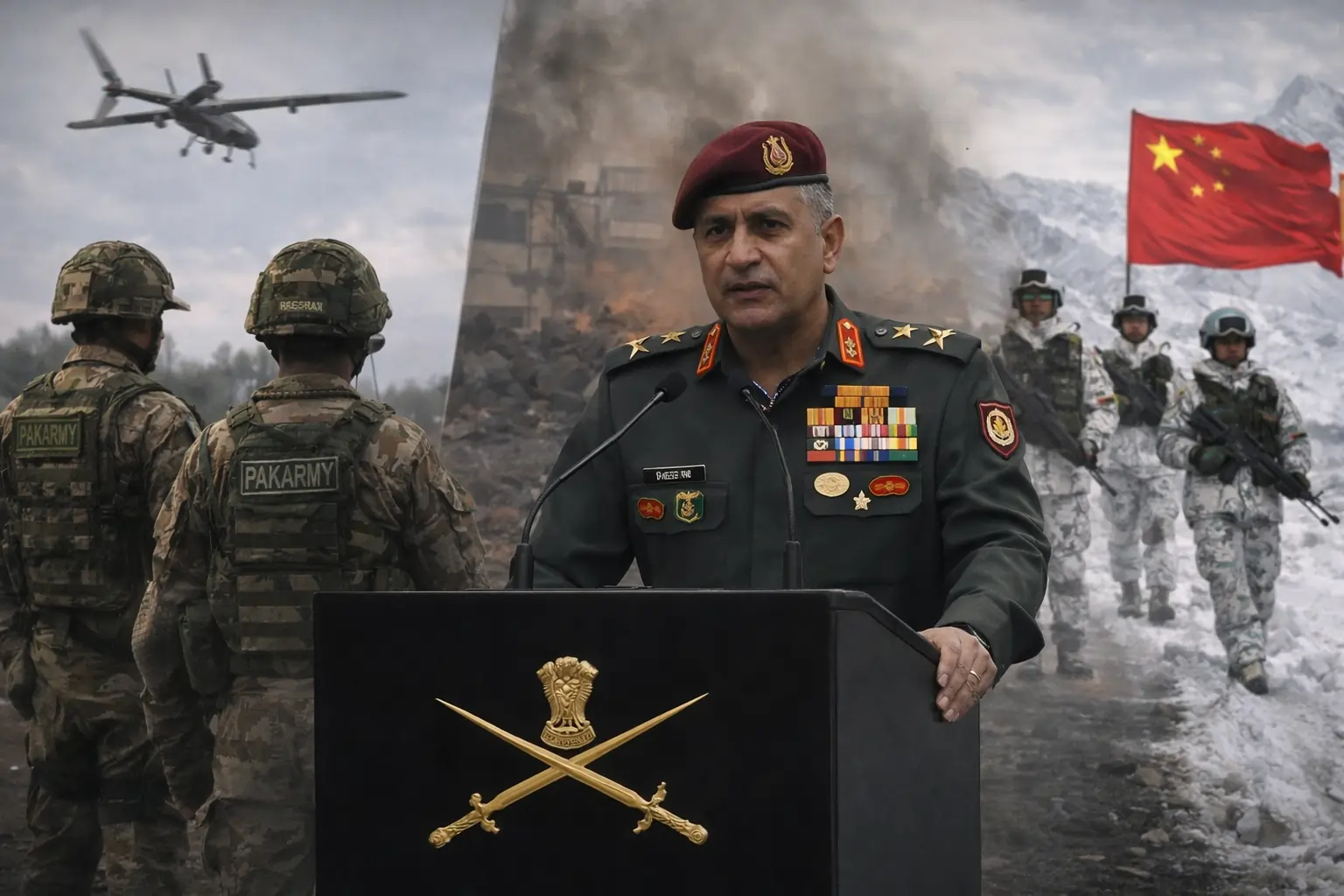
On 13 Jan, 2026, Indian Army Chief General Upendra Dwivedi delivered his annual press briefing in New Delhi ahead of Army Day. The briefing covered India’s security landscape, including reflections on the May 2025 conflict, border security, terrorism, drone activity, and modernization. The statements offered insight into India’s strategic posture, though they were met with differing interpretations regionally, particularly from Pakistan.
Operation Sindoor and the Legacy of May 2025
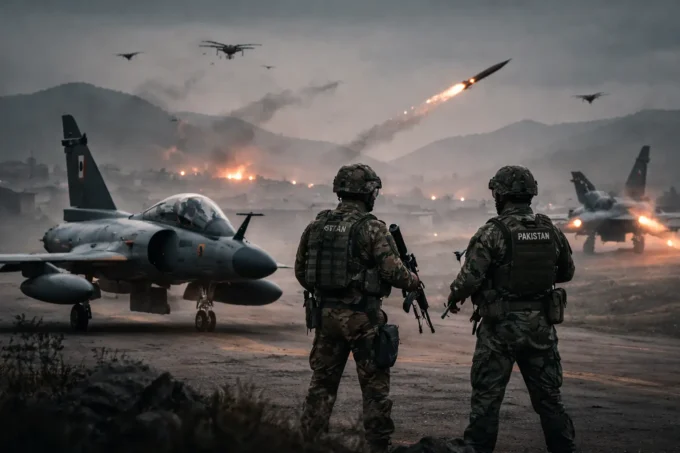
General Dwivedi revisited the May 2025 conflict and Operation Sindoor, describing it as an effort to neutralize militant infrastructure along the western frontier. The operation, conducted over 88 hours from 7 May to 10 May , was intended to demonstrate readiness for potential escalation. Reports indicated that over 100 militants were neutralized, and Indian forces moved in a coordinated manner across Army, Navy, and Air Force units.
However, reports from the same period suggest that strikes also affected civilian infrastructure, including mosques, homes, and the Neelum–Jhelum Hydropower Plant, drawing criticism for targeting non-military sites. On 10 May, Pakistan reportedly targeted 26 sites within India, including Sirsa, Udhampur, and Adampur airbases, indicating deep retaliatory capabilities. These events illustrate the escalation risks inherent in cross-border clashes and highlight the toll on civilian areas.
Border Security and Counter-Terrorism
Dwivedi emphasized ongoing cross-border terrorism threats, noting eight active terrorist camps across the LoC and IB. He highlighted a reduction in militancy in Jammu and Kashmir, citing 31 militants neutralized in 2025 and reduced local recruitment. However, external observers note that cross-border security remains a point of contention, with differing interpretations on the scale of threat and attribution.
Pakistan’s narrative emphasizes political and structural aspects of unrest, suggesting that militancy in the region cannot be solely linked to cross-border activity. This perspective highlights the complexity of the security environment where operational claims are interpreted differently by both sides.
Drone Activity and Attribution Challenges
A significant portion of Dwivedi’s briefing addressed unmanned aerial vehicle (UAV) incidents. Multiple drone sightings were reported along forward areas, with some UAVs allegedly carrying weapons. These incidents were officially communicated to Pakistan at the DGMO level.
However reports suggested that many of these drone events remain unverified. Displayed wreckage often involved of commercial off-the-shelf (COTS) parts with no identifiable serial numbers or manufacturing trails. Experts suggest that non-state actors could be responsible and that some launches may have occurred from short ranges (5–10 km from the LoC). In many interferences, debris was absent, leading to the conclusion that over 70% of reported drones could be false positives or “ghost drones.” This raises questions about attribution and operational assumptions in the region.
Terrorism and Regional Stability in Jammu & Kashmir
Dwivedi stressed that terrorism in Jammu & Kashmir remains a priority, with foreign nationals constituting a significant portion of active militants. Security indicators such as election participation and pilgrimages were cited as positive signs. While these factors suggest some stabilization, independent observers caution that regional security remains fragile and subject to broader political dynamics.
Pakistan continues to frame unrest in political terms, emphasizing governance, historical grievances, and the broader socio-political context rather than attributing all activity to external actors.
Ceasefire and Diplomatic Context
General Dwivedi mentioned that the western front and LoC remain sensitive, yet manageable. They have an active ceasefire mechanism since May 2025. He appreciates the influence of foreign diplomatic initiatives that contributed to the resolution of the situation. On the Pakistani side, the emphasis is on the ongoing conflict and its outcomes, especially with the introduced events of nuclear escalation, hence the call for strategic stability and deterring factors as the most vital tools for crisis management.
Northern Borders and China
Dwivedi characterized the LAC with China as stable, yet vigilance is still needed. There is a focus on confidence-building measures and strong deployments in the high altitude areas, a testament to India’s cross frontier challenge. There is also the complexity of collusive, yet non-LAC, Pakistan watching the region closely, especially given its aligned strategic partnerships.
Dwivedi’s emphasis on vigilance along the northern front also comes as China hardens its territorial posture. Beijing’s recent move to reinforce its claim over the Shaksgam Valley highlights the broader strategic pressure India faces beyond Pakistan. Read more
Modernization and Technological Advancements
The briefing acknowledged the process of modernization undertaken by India. It included a reference to the more than 90% indigenized ammunition and the ongoing process of structural changes such as the formation of Integrated Battle Groups (IBGs). There were references to specialized units like the Bhairav commandos, Divy Astra artillery batteries, and also the assimilation of AI and loitering munitions.
While the steps show a movement towards technology-backed operations, the effectiveness of these skills during active conflicts is still a work in progress. Pakistan wants to talk about how it distracts and modernizes its defense, zeroing in on how it has to keep a credible response posture.
Security At Home and the Neighborhood.
Dwivedi, too, spoke about stabilizing Manipur and the northeast, saying the political thaw in Myanmar is good for security. India is aware of the geography and how it all comes together, especially in terms of its internal and immediate surroundings.
Strategic Messaging and its Regional Impact
General Dwivedi’s briefing conveyed India’s intent to maintain operational readiness, counterterrorism efforts, and modernization, while situating security developments within a diplomatic and regional context. However, regional responses indicate diverging narratives. Pakistan emphasizes sovereignty, deterrence, and caution, while challenging attribution of certain incidents, particularly drone activity and militant operations. The divergence highlights the complex interplay of operational reporting, perception, and strategic signaling in South Asia.
The 2026 briefing provides insight into India’s security priorities, including border vigilance, counterterrorism, modernization, and technology integration. It also underscores the challenges of verification, civilian risk, and regional interpretation. Pakistan’s responses emphasize restraint, strategic credibility, and alternative interpretations of events. The security environment in South Asia remains sensitive and multifaceted, shaped by operational developments, political considerations, and the broader strategic calculus of both countries.






Leave a comment