



Bangladesh and India have recently witnessed a freezing of relations after the ouster of the ex Bengali leader Sheikh Hasina wajid. The interim government and New Delhi faced a failure in rebuilding the mutual confidence that once existed during the reign of Hasina.Hasina’s ouster and her refuge in India has become a matter of political and diplomatic tussle between New Delhi and Dhaka.
In a report published by the International Crisis Group (ICG) on Tuesday the group stated that the special relationship India had forged with the Hasina’s Awami league, and the uncompromising support which she and her party got from New Delhi despite her victory in three of the most controversial elections in the history of the country; fuelled antiIndia sentiment in Bengalis, especially the youth, who eventually led movement to oust her from power.
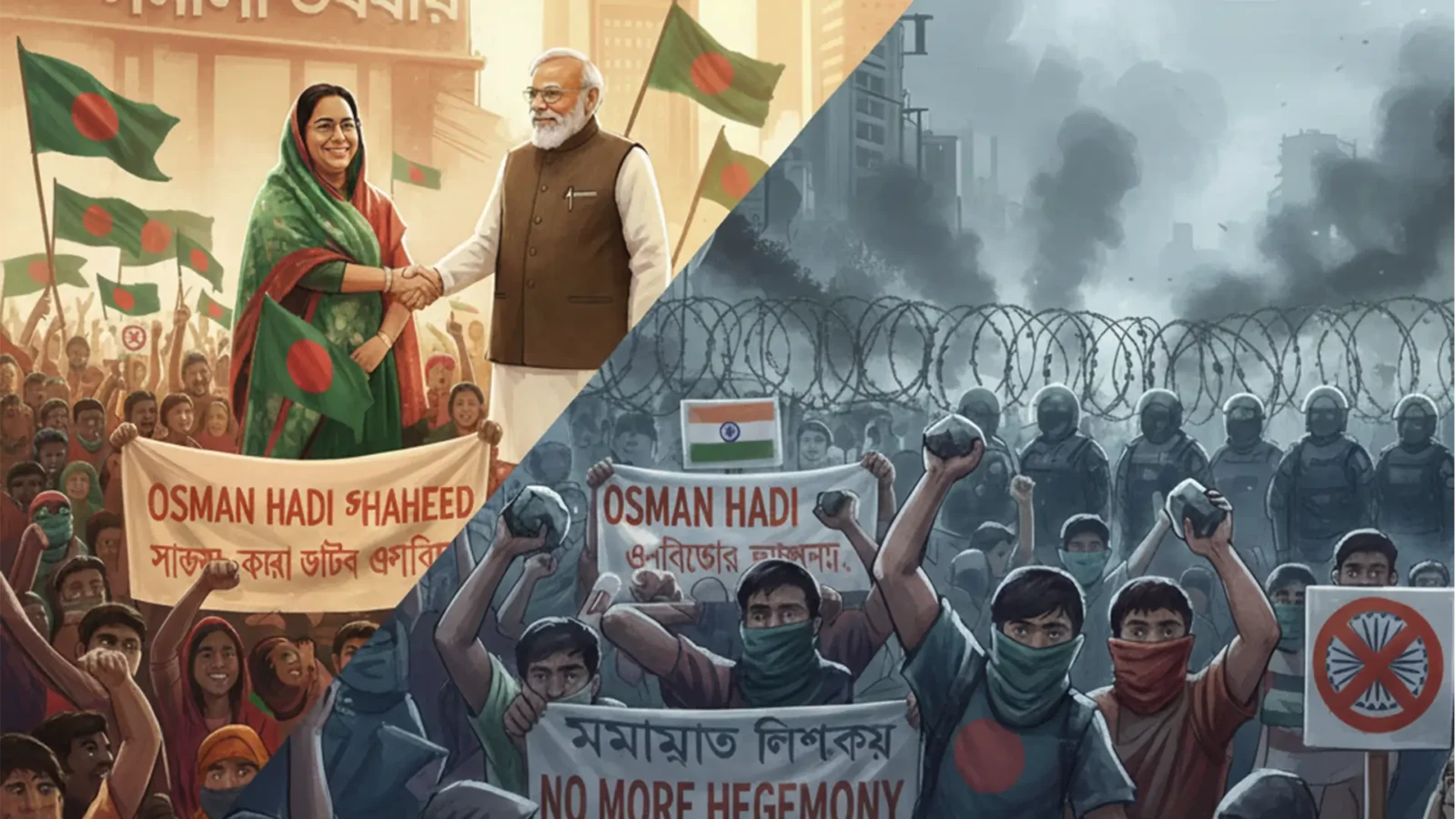
Furthermore, the killing of anti India firebrand leader of a bangladeshi revolutionary party, Osman Hadi has once again resulted in severing relations between the two countries. On December 15th, Osman Hadi, a leader of Inqilab Moncho, and a well known Bengali revolutionary died in Singapore hospital after being shot by unknown gunmen on December 12th.
Bangladeshi ex Prime Minister Hasina Wajid was ousted last year following protests led by revolutionaries, student unions and her political opponents. The woman who was the heir to the founding father of the country, Sheikh Mujib ur Rehman, was herself left with no other option, then to flee to India.
On August 5th 2024, following widespread protests throughout the country and state led violence, Hasins Wajid had to flee to India in a military helicopter, as the reports stated that she landed in Agartala. The protests started with the demands to revoke the job quotas for children of the freedom fighters of the 1971 war, which escalated into an anti-government movement,finally resulting in overthrowing the regime of Sheikh Hasina Wajid.
Following is the timeline of events that led to protests and eventually the resignation of Hasina Wajid.
July 2024 Blockades:
On July 1st 2024, students around the country started initiating blockades, blocking rods and railway lines, which marked the start of the movement.Students started demanding reforms in job quotas and reservations, which theft claimed were aimed at benefitting the children of 1971 freedom fighters, who were loyalistas of Hasina’s Awami league.
July 16 Violence Intensifies:
Six students were killed in clashes between the protestors and Police, as Sheikh Hasina Wajid ordered the security forces to use lethal force against the protestors. Recording analyzed by Al Jazeera proved that Hasina’s forces used lethal force, even using fire from helicopters, live fire, and brutal crackdown on protestors. Hasina’s government ordered the closure of educational institutions and corporate offices.
July 18, 2024, Hasina Went Rogue:
The protestors rejected the call made by then PM Sheikh Hasina, calling for calm, and continued demanded her resignation along with the reforms in the
Job quotas. Hasina, baffled by the response of the protesters, announced the suspension of internet services in the country and ordered police to use lethal force.
This resulted in the death of 32 students in the country, which further frustrated the students. Slogans like, “down with the dictator” were raised by protestors who torched the building of the state television, along with other state buildings.The protests were now being led by the students against discrimination; a platform of student activists formed in 2024.
July 21, 2024, Supreme Court Sides With Hasina:
An important event was when the Supreme Court of Bangladesh sided with the Hasina led government. The court ordered against reintroducing job quotas, though it announced sharp cuts in job quotas and reservations, the decision failed to satisfy the demands of the protestors who wanted a complete overhaul of the job system in the country.
August , 2024, Army Sides With Public:
An important development was witnessed on 4th August when the Army announced to side with the protestors.This happened after another episode of violence which resulted in 68 deaths, including 14 police officers after the clashes between the government force and the protestors in Dhaka. Army Chief, General Waker ur Zaman advised the government not to use brutal force against the protestors and was quoted as saying:
“the army sides with the people.”
August 5, 2024; Final Call and Hasina’s Resignation:
On 5th of August, student leaders announced a final call and civil disobedience was announced against Hasina led government, until she announced her resignation. Mobs attacked the state buildings including the Prime Minister house, parliament, many statues of Sheikh Mujib ur Rehman were torched down, homes of Awami league members were vandalized and eventually Hasina announced her resignation.
Yunus Led Interim Government Announced:
On August 8th, an interim government under the leadership of Nobel laureate, Dr Muhammmad Yunus was announced to manage affairs of the country until elections are held, which is running till date. The elections are scheduled to be held on February 12th.
Since the ouster of Sheikh Hasina, Dhaka and New Delhi have witnessed a freezing of relations, where the Dhaka side has repeatedly demanded New Delhi to focus on bilateral ties, and hand over Hasina back to Bangladeshi authorities to face justice for actions against protestors and assault on democracy. A Bangladeshi court has already announced the death sentence for the ex leader, for crimes against humanity.
India is facing a dilemma in Bangladesh since Hasina’s ouster for multiple reasons. First, it has the very ally which India had cultivated for decades. Secondly, the Awami league has been barred from elections and therefore India cannot expect its return in the upcoming elections.
Thirdly, the personal support India gave to Hasina has fuelled anti India sentiment in Bangladesh to the point of no return, where the majority of Bangladeshi have been actively voicing against India, many threatening hindus too. Similarly, the killing of Osman Sharif Hadi, spokesperson and co-founder of Inqilab Moncho has resulted in further deterioration of relations.
This diplomatic chill also fits into a larger trend of escalating regional rhetoric in South Asia, detailed in this analysis on India–Pakistan–Bangladesh relations:
https://indiadecode.in/rising-india-pakistan-bangladesh-rhetoric/
Where India went Wrong and What to Expect In Future
India and its subsequent governments, be it BJP or Congress have described the [post 2008 era as the golden era in the bilateral relations between the two countries. The era which has been the source of growing resentment must have been taken into consideration and immediate actions had to be taken by New Delhi to take the Yunus led government into confidence. Rather as the International Crisis Group Argues, India has decided not to mend ties with the Yunus led government, rather waiting for the elections.
ICG argues that the best outcome India might be looking for is a victory of the Tarique ur Rehman led BNP. Tarique has recently returned back after a 17 year exile, and had a warm welcome by hundreds of thousands. What the Modi led Indian government is missing is that BNP and India had strained relations, even from the times of ex leader, Zaia ur Rehman. Although, it is also true that at the moment, because of the historical mistakes and lack of introspection, this is the only outcome, which can be considered most favorable for India.
The group further warned that the growing hostility between the two states can result in scenarios that can involve violence, short of war, including violent protests, communal hatred, and to the point of border clashes. The need of the time is for self introspection for Indian policy makers, otherwise there will be no time when India can lose its once most reliable ally in the South Asian region.
Since Sheikh Hasina’s ouster and her flight to India, ties between Dhaka and New Delhi have sharply deteriorated, with The Economic Times noting a clear downturn in India–Bangladesh relations amid Bangladesh’s turbulent political transition.
https://economictimes.com/ties-with-india-witness-a-downturn-as-bangladesh-navigates-turbulent-2025
Where there is a need that whichever political group gains power in the 2025 elections, must adopt a balanced foreign policy, it’s also important for Indian policy elites to focus on ties with the Bangladeshi state, and not with Hasina and her party.