





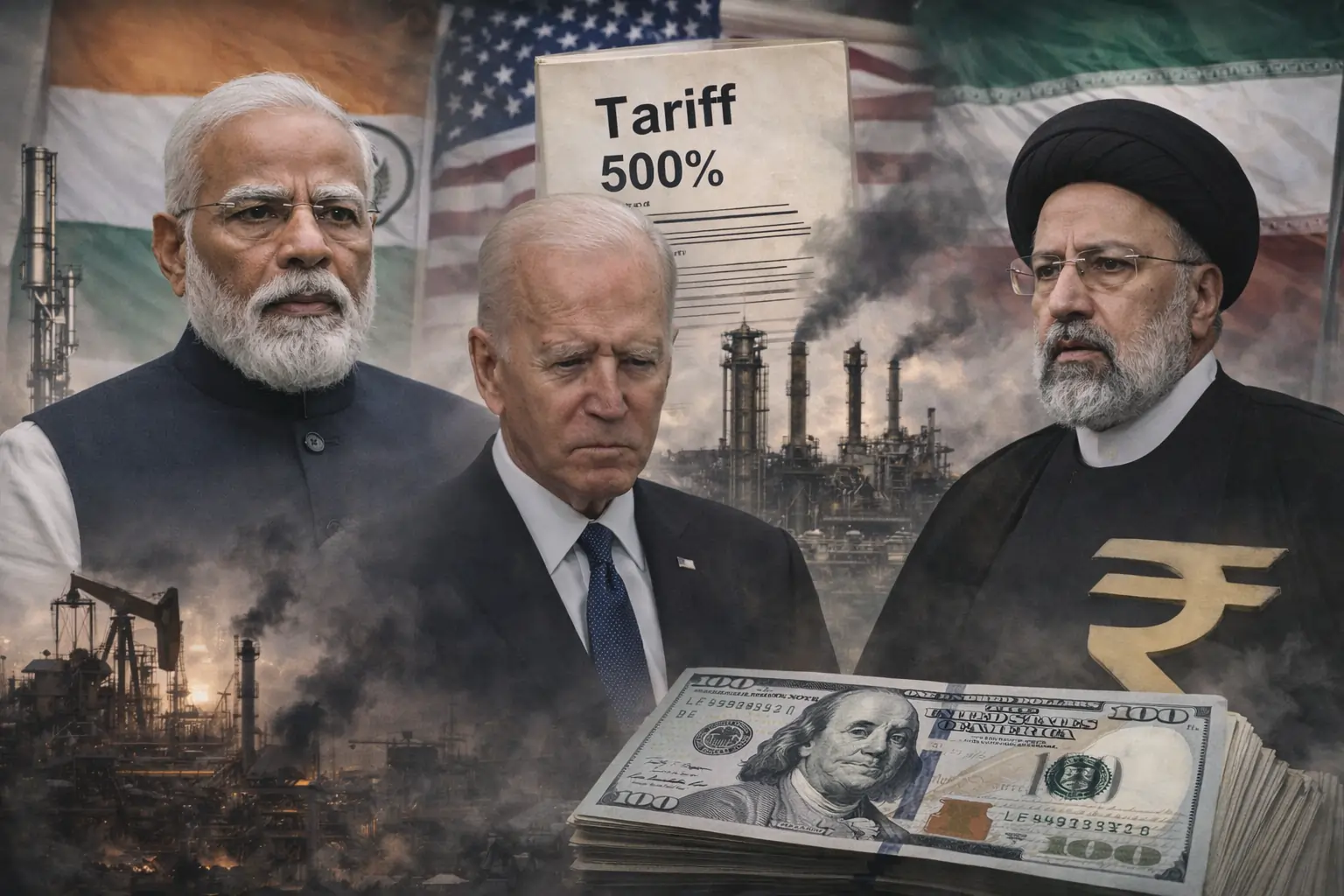
For decades, the cornerstone of Indian foreign policy has been “strategic autonomy” the ability to maintain independent relationships with rival powers based on national interest rather than bloc loyalty. However, as 2026 unfolds, this long-held doctrine is facing an existential crisis. The recent ultimatum from Washington a 25% tariff on any nation trading with Iran has not just dented India’s economic ambitions; it has exposed a fundamental inability to balance the competing demands of the West and the Global South.
While New Delhi has spent years projecting itself as a bridge between worlds, the current geopolitical climate suggests that the bridge is buckling. India is no longer balancing; it is retreating into a corner of pragmatism that looks increasingly like a loss of sovereign choice.
The Pipe Dream, Chabahar and the Cost of Indecision.
The most obvious victim of this balancing act failure is the Chabahar Port. In the Sistan-Baluchistan province of Iran, Chabahar was to be the gateway to Central Asia to India and a direct competitor to the presence of the Chinese in the Gwadar port of Pakistan. India has invested millions in this project considering it as an important strategic artery avoiding her belligerent neighbor. However, even after signing a management contract of 10 years and investing a whole half a billion, the port is still a target of the Washington mood.
The aspect of India mostly depending on sanctions waivers has made its most important investment in the region become a liability. With the US being left to establish the conditions under which and when it can conduct business in a foreign land, India has sent a message that its connectivity to the region is less important than approval by the Americans.
The failure of analysis, in this case, is that of foresight. New Delhi took a risk that its increasing value to the US as countering China would provide it with immunity forever in its relationships with Tehran. That gamble has failed. The fact that the Trump administration is prepared to employ 500% tariffs as a geopolitical club demonstrates that to Washington, the so-called strategic partnership with India is more of a transactional relationship as opposed to a marriage. The silence that India has shown towards these threats is no quiet diplomacy, it is a symptom of strategic paralysis.
(see Indian Express analysis on Chabahar’s sanctions exposure):
Read More
The Crisis of Rice: The Geopolitics meets the Farmer.
The effects of this failure are not limited to the halls of power; this is being experienced in the rice paddies of Haryana and Punjab. Iran has been a traditional importer of the Indian Basmati rice in large quantities. The trade today is at a free fall. Scared of being shut out of US financial system or being a victim of secondary tariffs, Indian exporters have halted shipments.
This creates a bitter irony. India, which is already at the highest grain stocks in history with a bountiful harvest is unable to sell its excess to a long-term ally due to a Washington D.C. policy. It is not merely a trade hiccup but it will be a display of how domestic food security and agricultural economy of India is now indirectly controlled by the US Treasury Department.
The focus of Indian 21 st century trade has been to be the International North-South Transport Corridor (INSTC), the goal of this was to connect India to Russia through Iran. But, as the US now puts all trade with Iran in its range, the INSTC is practically a dead-end to any Indian company that has international ambitions. The failure to ensure that this corridor is not subjected to external political influences is an enormous failure to create a resilient self-sufficient trade infrastructure.
(see Livemint on Chabahar, INSTC, and sanctions risk):
Read More
A Slippery Slope: The Russian Oil Precedent.
In helping to understand why India is not balancing Iran and the US, one should examine how it has been dealing with Russia recently. In 2025, the same happened to India concerning the discounted Russian oil. Although New Delhi was initially resolute, the threat of tariff of 500 percent, an ultimate escalation of a freeze of trade, compelled it to quietly but decisively switch to US and Middle Eastern energy sources. It set a very dangerous precedent, the strategic autonomy of India comes at a price. Washington is now aware that given the seriousness of its approach through economic sanctions, New Delhi can one day be made to give in to save its $129 billion export business in the US.
This is why the multi-alignment strategy of India appears more of an act of tactical retreats. India is asserting the fact that it is squarely in the American economic circle, regardless of its rhetoric of being a Vishwa Mitra (Friend of the World) by opting to choose the US market over the Iranian connectivity.
The Afghanistan Void
Failure by India to control the Iran relationship is also fatal to its position in Afghanistan. India is virtually handing over the theater in Afghanistan to the Pakistani-Chinese influence by losing the secure utilization of the Chabahar-Zaranj-Delaram route. As a nation that boasts of being a regional security provider, not to be able to access its northern neighbors due to its inability to sail through the tensions between the US and Iran is a big setback in terms of diplomatic relationships.
The fact that the present-day recommendation to the Indian nationals not to travel to Iran by the New Delhi is a tacit acceptance by the country that India has lost faith in stabilizing its interests there. Rather than positioning herself in the head of a regional alliance to maintain the openness of trade routes, India is retreating with the hope of sitting back and waiting to ride out the storm, a practice that is hardly effective in the dynamic environment of contemporary geopolitics.
The Myth of the Global Bridge.
The basic criticism of the current status of India is that India has not created the economic or military advantage that it could utilize in order to actually balance. An honest broker is able to bring concessions out of both parties. Both India, on the other hand, are being squeezed. The weakness of India lies in its economic reliance on the US market. India, due to its lack of diversification in its export destinations and excessive dependence on Western technology and capital, cannot legitimately say no to Washington.
This forms an unequal relationship in which the US determines the red lines and India just operates within these red lines. Additionally, the failure of India to adopt a definite public position on the tariff threats also shows a lack of confidence in the strategy. The effort to appease all is turning New Delhi into an untrustworthy partner of the Global South and an inferior partner of the West. The middle path is only effective as long as you are strong enough to remain on it otherwise you will merely be struck down by traffic coming in each way.
India often cites its defence partnership with France as evidence that strategic autonomy still exists. The 114-fighter Rafale strategic accord demonstrates New Delhi’s ability to work with non-U.S. partners without political conditionalities, as detailed in India and France Strategic Accord for 114 Rafale (Read More). However, defence autonomy cannot offset economic dependence—France may supply jets, but it cannot shield India’s trade, energy, or regional connectivity from U.S. sanctions pressure.
The End of the Balancing Act?
As we move deeper into 2026, the facade of strategic autonomy is crumbling. India’s inability to protect its investments in Iran, its failure to secure its agricultural exports, and its compliance with US energy dictates suggest that the era of balancing is over.
India is currently a passenger in a geopolitical vehicle driven by Washington. While this may provide short-term economic safety and access to the massive US market, it comes at the cost of India’s long-term goal of becoming a pole in a multipolar world.
If India cannot trade with its own neighbors or utilize the ports it built without checking with the US State Department, it is not a “leading power” it is a protected state. The transition from a “balancer” to a “compliant partner” may be a pragmatic necessity for India’s GDP, but it is a monumental failure of its diplomatic vision. The question is no longer how India will balance the two, but how much more of its strategic independence it is willing to trade for market access.
For further context on how India’s claims of independence in global affairs are being critiqued, see The Paper Tiger of the Global South — India (Read More), which argues that India’s strategic autonomy has often been more rhetorical than real.






Leave a comment