

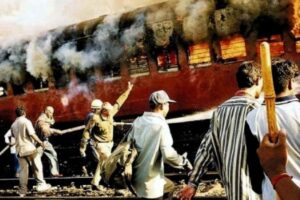



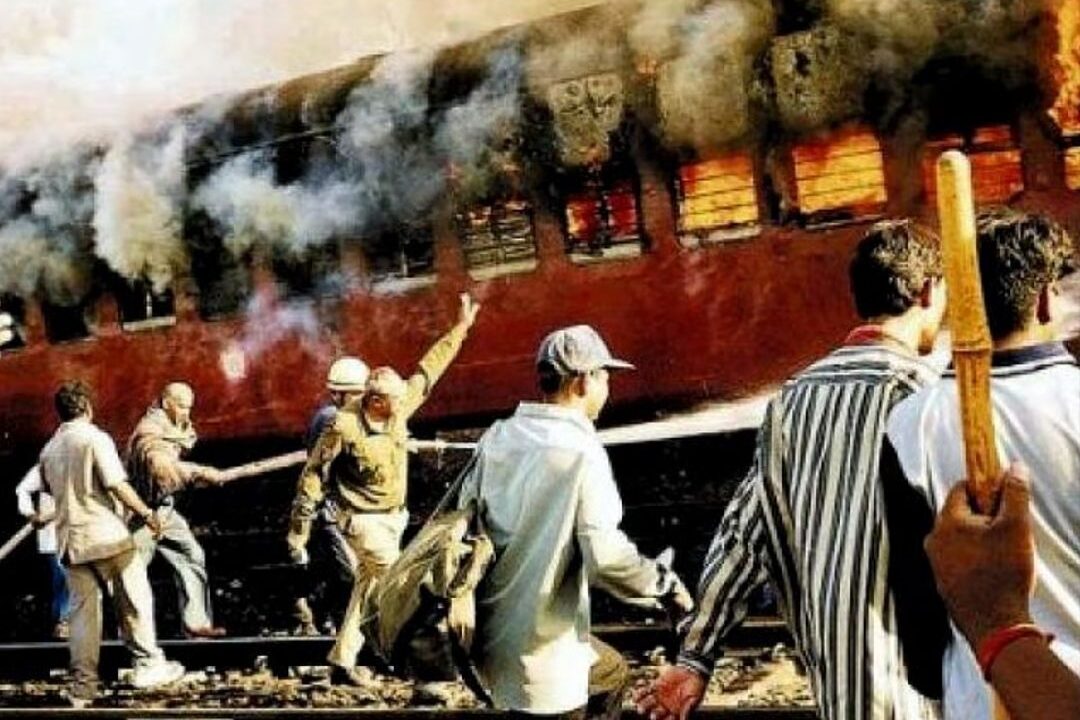
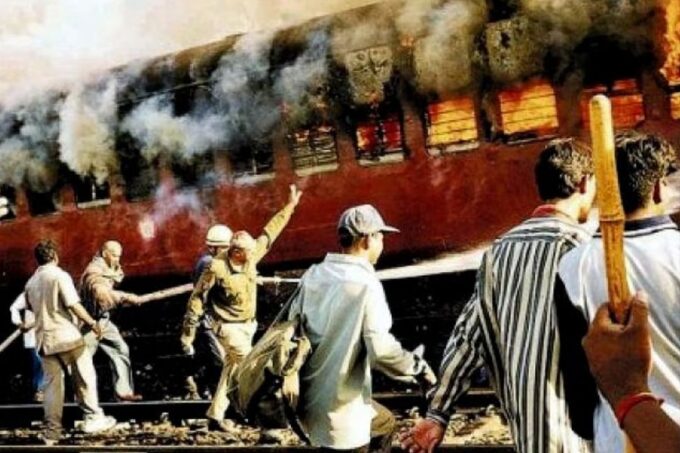
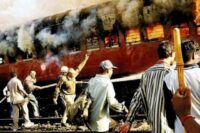
On the morning of 27 February 2002, the Sabarmati Express pulled into Godhra station in Gujarat. Within minutes, the S-6 coach of the train caught fire and was engulfed in flames. By the time the fire was extinguished, 59 pilgrims returning from Ayodhya had died. Soon after the tragic incident the rumours of a communal conspiracy began to spread across the state. The images of the charred coach travelled quickly across television screens and newspapers. Shock turned into outrage. Outrage soon spiralled into something far larger.
According to official records, the incident occurred around 7:43 a.m. near Signal Falia, close to Godhra station. The train had been delayed, and an altercation reportedly took place between passengers and local vendors on the platform. Soon after the train left the station, coach S-6 caught fire. Fifty-nine people, including women and children, died from burns and smoke inhalation.
The immediate question was whether the fire was accidental or Conspiracy. The Gujarat government treated it as a planned attack by the Muslim community as the region where Sabarmati express caught fire was a Muslim dominant area. The fire at the Sabarmati express turned into a spree of violence and blood shed across Gujarat which lasted for weeks to follow. The Right-wing print and electronic media displayed the images of the incident repeatedly and early media conclusions without any investigations brought the anti-Muslim sentiment to a point where Hindu mobs began to massacre Muslims across the state.
Beginning on 28 February 2002, large-scale communal violence spread across Gujarat. According to data submitted by the Gujarat government before the Supreme Court, 1,044 people were killed in the riots that followed. Over 2,500 were injured, and more than 200 were reported missing. Independent groups have estimated higher death tolls. Thousands of homes and businesses were destroyed, and tens of thousands were displaced into relief camps.
The scale and intensity of the violence raised serious questions about law enforcement response, administrative preparedness, and political responsibility. Over the years, several major riot cases were reinvestigated under the supervision of a Supreme Court-appointed Special Investigation Team. Convictions were secured in some high-profile cases. In 2022, the Supreme Court upheld the SIT’s findings rejecting allegations of a larger criminal conspiracy at the highest levels of the state government.
For many, these rulings marked legal closure. For others, they did not settle moral or political debates. That is precisely why Godhra remains more than a criminal case. It is a defining memory of the various communities which became victim to the ensuing violence.
In moments of communal tension, facts are often the first casualty. Rumour travels faster than verification. Emotion overwhelms restraint. The Godhra train burning demonstrates how a single violent event, when layered onto existing mistrust, can trigger cascading consequences across an entire state.
It also exposes the fragility of social cohesion. India is a plural society with deep religious diversity. Peace in such a society depends not only on institutions, but on restraint, political, social, and rhetorical. When leaders, media, or communities fail to de-escalate, the cost can be measured in lives.
The burning of coach S-6 was a crime that killed 59 people. The violence that followed killed more than a thousand. Recognizing both facts is not a contradiction. It is an obligation. The ensuing rampage and pillage that mainly targeted Muslims left deep scars of the collective consciousness of Gujaratis. The courts delayed the processes to the point where seeking justice became irrelevant for the victims and Perpetrators of the massacres across Gujarat roamed freely without any repercussions.
In 2008, a Special Court was set up to try the case of Godhra incident. In 2011, that court convicted 31 individuals, concluding that the burning was the result of a criminal conspiracy. Eleven were initially sentenced to death and 20 to life imprisonment.
However, the judicial story did not end there. In 2017, the Gujarat High Court upheld the convictions of several of the accused but commuted the death sentences to life imprisonment. The Court maintained that the incident was a premeditated conspiracy carried out by a mob. At the same time, it acquitted others for lack of sufficient evidence. Like many complex criminal cases, the verdict reflected both certainty and limitation, accountability for some, unresolved questions for others.
Parallel to the criminal trial, the Nanavati–Mehta Commission, appointed to investigate both the Godhra incident and the violence that followed, submitted its final report in 2014. It supported the conclusion that the train burning was a conspiracy. Critics, however, raised doubts about aspects of the investigation, including forensic interpretations and witness reliability. Alternative theories, including accidental fire scenarios, were debated publicly, though they did not prevail in court.
Interestingly, the U.C. Banerjee commission, appointed by the UPA government’s railway minister, Lalu Yadav, arrived at the opposite conclusion and found that the incident was not a conspiracy but an accident. The U.C. Banerjee report, however, conveniently put aside and never consulted for the incident’s details as the report was challenged by the Gujarat’s government for having no jurisdiction or legal standing.
These competing interpretations reveal how quickly tragedy becomes contested terrain. If there is a lesson in Godhra, it lies in how swiftly outrage can become collective punishment, how grief can be manipulated into division, and how fragile public order can be when institutions falter under pressure. Godhra was a fire in a railway coach. But its consequences extended far beyond steel and smoke. It ignited political careers, hardened communal identities, reshaped electoral discourse, and left scars that have not fully faded. History does not demand perpetual anger, but it does demand clarity.
The events of 27 February 2002, and the weeks that followed, remind that justice must be pursued through courts, not mobs, and accountability must be determined by evidence, not rumour. There is no justification for the idea that one tragedy should become the pretext for another.





Leave a comment