







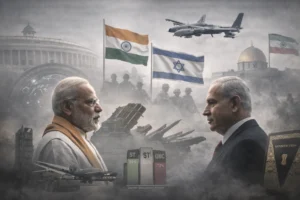
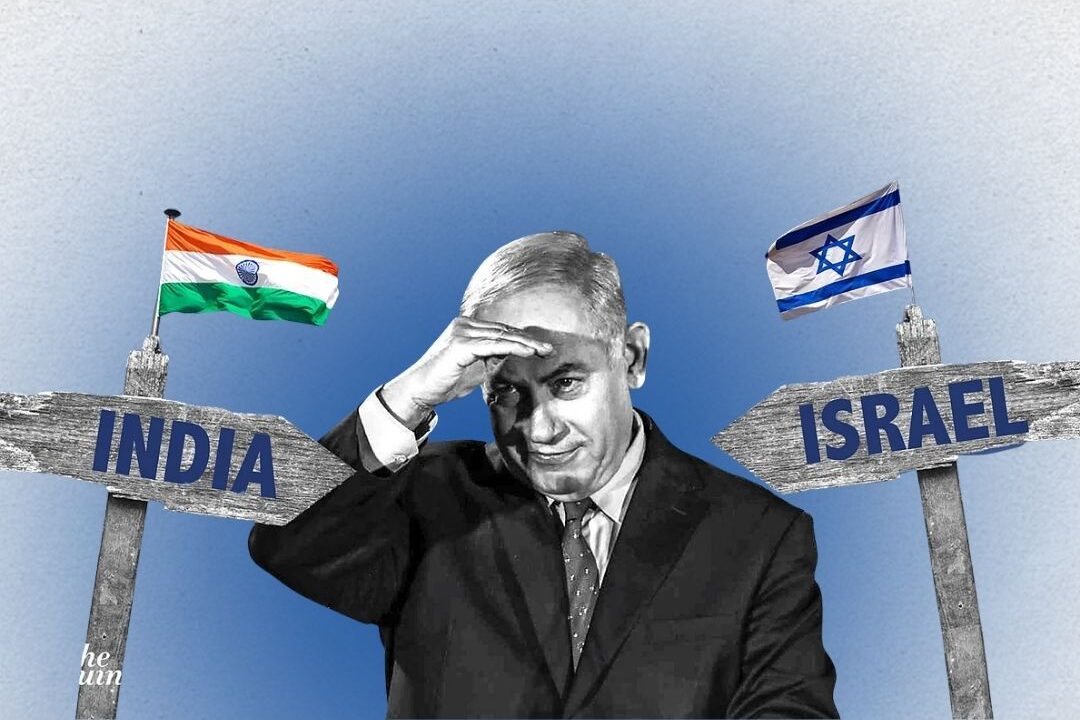
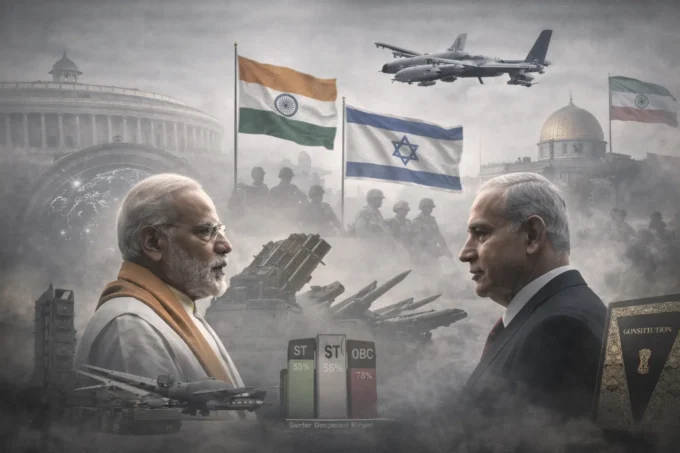
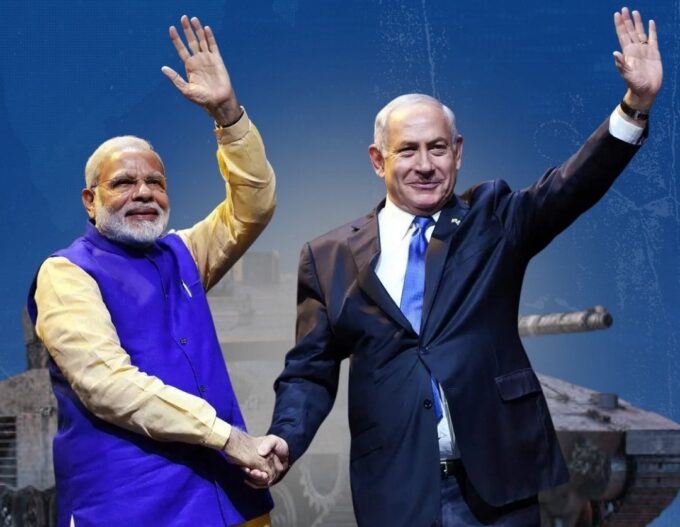
When Mahatma Gandhi wrote in 1938 that imposing a Jewish homeland on Arab land would be “a crime against humanity,” he couldn’t have imagined that eight decades later, an Indian Prime Minister would embrace Israel’s leader as a “tremendous alliance” partner while Israeli weapons devastate Palestinian lives. Narendra Modi’s February 25, 2026 visit to Israel-his second as PM isn’t about diplomatic niceties. It’s about closing an $8.6 billion arms deal that transforms Israel into India’s largest weapons supplier after France, and turning both nations into a joint military-industrial complex that tests weapons on occupied populations before exporting them globally.
The Numbers Behind the Bromance
India accounts for 37% of Israel’s total arms exports, making it Israel’s most reliable buyer. Between 2020 and 2024, India purchased $20.5 billion worth of Israeli military hardware, according to Israel’s Defense Ministry International Defense Cooperation Directorate (SIBAT). During Operation Sindoor against Pakistan in 2025, India deployed Rampage missiles, Palm 400 systems, Harpy loitering munitions, and Harop kamikaze drones, all Israeli made devastating targets near Islamabad. The “achievement” of these battle-tested weapons has now accelerated $8.6 billion in new deals Modi will settle during his Israel visit.
The shopping list is staggering: Iron Beam laser defense systems, Barak-8 surface-to-air missiles, SPICE 1000 precision-guided bombs, Air Lora air-launched ballistic missiles, Ice Breaker long-range systems reaching 300km, and 425,000 carbine assault rifles from the Adani-Elbit joint venture. Israel has agreed to provide “full access” to cutting edge defense technologies, including advanced laser defense and standoff systems, marking an unparalleled technology transfer. As SIBAT head Brig. Gen. Yair Kulas told Globes:
“Israeli industry now understands that it must have a local manufacturing foothold, while Indian companies need technology transfer.”
The Palestine Laboratory Comes to Kashmir
Author Antony Loewenstein wrote in “The Palestine Laboratory”: “What Israel develops and perfects in Palestine, it exports to conflict zones globally.” India isn’t just buying weapons-it’s importing occupation strategies. Israeli intelligence operatives have allegedly participated in interrogations in Kashmir Valley. Israeli generals provide guidance at Indian military bases in Kashmir. Indian troops train in Israel, learning tactics both governments frame as combating “Islamist terrorism.”
The weapons pipeline flows both ways. During Israel’s Gaza genocide, Indian-made weapons docked in Israeli ports, according to foreign media reports. Adani Corporation produces the Drishti 10 Starliner drone based on Elbit Systems’ Hermes 900-the same company whose weapons and surveillance systems are employed along walls and checkpoints in occupied Palestine and have been targeted for complicity in war crimes. As Professor Apoorvanand of Delhi University explains:
“Hindutva supporters admire Zionism because they see it as a successful model of subjugating and controlling a Muslim population.”
The November 2024 India-Israel MoU outlined joint development of surveillance systems, predictive policing software, and AI-based military technologies-tools already installed in Kashmir. Smart fences, sensors, drones tested on Palestinians are now controlling Kashmiris. Israeli agritech and water management technologies emerging from military, backed research institutions are being imported alongside the weapons. From weapons to governance strategies, Israel provides the blueprint for population control that Modi’s government eagerly adopts.
Modi and Netanyahu: Partners in Tested-on-Civilians Tech
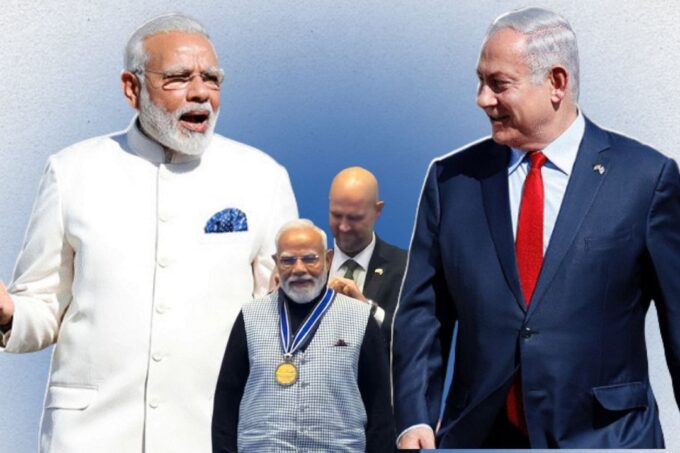
Modi’s 2017 Israel visit the first ever by an Indian PM-marked the open embrace. In 2022, Israeli Defense Minister Benny Gantz signed the “India-Israel Vision on Defence Cooperation” agreement laying out a 10-year roadmap. Trade jumped from $200 million in 1992 to $6.5 billion in 2024. The Indian Air Force participated in Israel’s Blue Flag-2021 exercise. Far-right Israeli ministers like Bezalel Smotrich-sanctioned by Western allies- are welcomed in India. Netanyahu told the Conference of Presidents of Major American Jewish Organizations that India, with 1.4 billion people, is “enormously powerful, enormously popular,” framing the partnership as a “hexagon” of alliances against “radical axes.”
The strategic logic is clear. As defense analyst Rajiv Kumar Narang from India’s Institute for Defence Studies and Analyses notes: “India’s arms trade with Israel began as a simple supplier-recipient relationship, but today it has evolved into co-development and co- production of military technology.” Israel gets guaranteed revenue-continuing “uninterrupted supply” to India even as it delayed $1.5 billion in arms exports to other countries since October 2023. India gets battle-tested weapons and occupation strategies. Both get plausible deniability-Israeli tech “made in India” through Adani and Tata partnerships can be exported across Asia without Israeli flags.
Netanyahu’s February 2026 statement revealing Modi’s visit dates before New Delhi announced them demonstrates who controls the narrative.
The Hypocrisy Gap: Belatedly Condemning West Bank While Buying Occupation Tools
On February 17, 2026, 85 countries condemned Israel’s West Bank expansion. India wasn’t among them, until 24 hours later, when it belatedly joined just days before Modi’s Israel visit. India condemned the “humanitarian crisis” in Gaza but repeatedly abstained from UN ceasefire resolutions. In 2024, India abstained from a UN Human Rights Council arms embargo resolution against Israel.
Modi’s pattern is clear: symbolic condemnations to maintain Arab relations and domestic Muslim voters, followed by $8.6 billion arms deals and warm embraces with Netanyahu. India officially supports a two-state solution while Modi addresses the Knesset celebrating “tremendous alliance.” Indian workers replace Palestinian laborers after Israel suspended their permits post-October 7, 2023. India maintains it’s “balancing” but the balance tilts overwhelmingly toward weapons procurement and occupation strategy imports.
Gandhi’s Nightmare, Modi’s Alliance
From Gandhi’s 1938 warning against imposing Jewish homeland on Arabs as “crime against humanity,” to Modi’s 2026 celebration of “tremendous alliance” with Netanyahu while Israel commits genocide in Gaza, India has traveled from principle to complicity. The $20.5 billion in weapons purchases 2020-2024, the $8.6 billion in new deals, the Adani-Elbit joint ventures producing drones, the Israeli tactics imported to Kashmir, the abstentions from Gaza ceasefire votes-all reveal a government that abandoned anti- colonial solidarity for arms bazaar partnership with an occupying power.
Netanyahu frames it as alliances against “radical axes.” Modi calls it strategic partnership. Congress calls it hypocrisy. The truth is simpler: India and Israel have built a military- industrial complex where weapons tested on Palestinians and exported globally, where occupation strategies perfected in Gaza get deployed in Kashmir, where “battle-proven” becomes the sales pitch for missiles that killed civilians. Modi’s February visit won’t just sign defense deals. It will cement India’s transformation from Gandhi’s moral clarity to becoming Israel’s largest Asian arms customer, complicit in occupation technologies marketed to the world as “counter-terrorism solutions.” When the weapons are tested on captive populations first-Palestinians, Kashmiris-and then sold globally as proven systems, both Modi and Netanyahu profit. That’s the real “tremendous alliance” a partnership in tested-on-civilians military tech disguised as strategic cooperation.










Leave a comment