








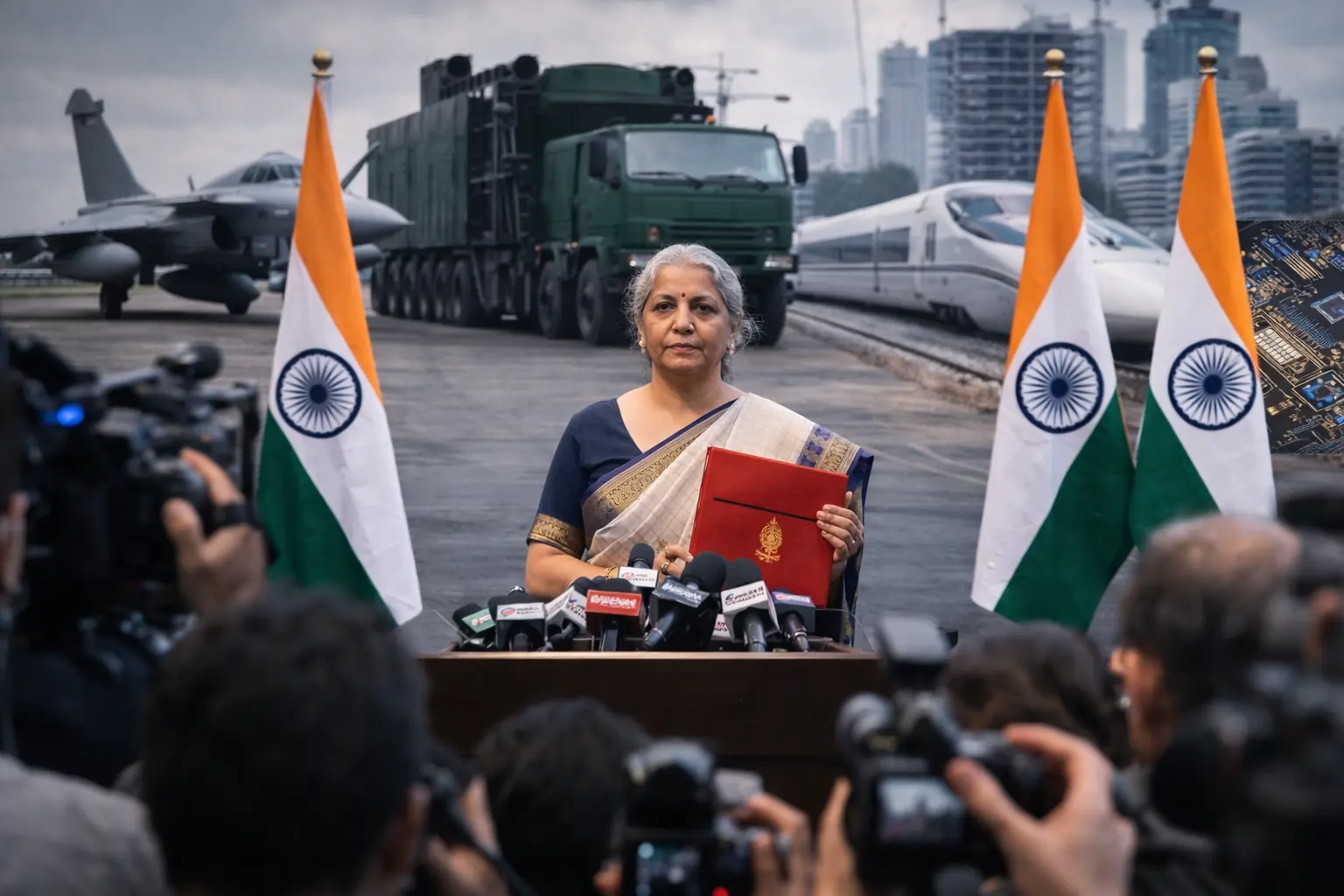
The Union Budget 2026–27, presented by Finance Minister Nirmala Sitharaman on 01 February, 2026, marks a watershed moment in India’s fiscal history. Traditionally, Indian budgets have been a delicate balancing act between populist measures and developmental goals. However, the current fiscal roadmap shaped by the recent Operation Sindoor conflict and an increasingly protectionist global trade environment signals a decisive shift toward a Security-First economic blueprint. By prioritizing military modernization, fiscal discipline, and high-tech infrastructure, the government is attempting to insulate the Indian economy from external shocks while cementing its position as a global manufacturing hub.
The Debt Dilemma: Prudence Over Populism
At the heart of the 2026 budget is an unwavering commitment to fiscal consolidation. The government has set a fiscal deficit target of 4.3% of GDP for FY27, a marginal but significant reduction from the 4.4% of the previous year. This adherence to discipline is a clear signal to global rating agencies and investors that India intends to maintain macroeconomic stability despite internal and external pressures.
The broader objective is to steer the central debt-to-GDP ratio toward 50% by 2031, down from the current estimate of 55.6%. To achieve this, the government is relying on a “Nominal GDP growth” target of 10%. While tax revenues are expected to grow by nearly 11%, the budget’s arithmetic depends heavily on non-tax receipts, including a projected ₹2.90 lakh crore dividend from the Reserve Bank of India. The challenge, however, remains the massive interest payment burden, which currently consumes roughly 26% of the total budget expenditure. This “debt trap” potential necessitates that every rupee borrowed must be funneled into productive capital assets rather than revenue subsidies.
Defense: The Operation Sindoor Catalyst
The most striking feature of this budget is the massive surge in defense allocation. In the wake of the 2025 conflict, the Ministry of Defense saw its budget swell to ₹7.85 lakh crore ($85.7 billion), a 15% jump that underscores a new era of heightened military preparedness.
Beyond the sheer numbers, the Capital Outlay the funds used for new weaponry and technology has increased by 22% to ₹2.19 lakh crore. This is not just spending; it is a strategic investment in modernization. With contracts for 114 Rafale jets, advanced submarines, and a swarm of indigenous uncrewed aerial vehicles (UAVs) in the pipeline, India is moving away from a defensive posture toward an “active deterrence” capability. Furthermore, by earmarking 75% of the procurement budget for domestic industry, the government is using defense spending as a secondary engine for the “Make in India” manufacturing initiative.
Infrastructure: Connecting the Growth Hubs
Infrastructure continues to be the primary driver of India’s growth story, with capital expenditure (Capex) rising to ₹12.2 lakh crore (approx. 4.4% of GDP). However, the focus has shifted from mere “nation-building” to “precision connectivity.” The budget introduces City Economic Regions (CERs), targeting Tier-II and Tier-III cities with populations over 5 lakh. By allocating ₹5,000 crore per CER, the government aims to decentralize growth away from saturated metros like Mumbai and Delhi.
The logistics push is equally ambitious. The proposal for a new Dedicated Freight Corridor (DFC) connecting Dankuni in the East to Surat in the West, along with seven new high-speed rail corridors, is designed to slash India’s logistics costs currently among the highest in the world. By improving the “speed of business,” the government hopes to “crowd in” private investment, which has remained tepid despite high public spending.
The High-Wire Act
The 2026–27 Budget is an exercise in strategic pragmatism, but it is not without significant risks.
- The Squeeze on Consumption: By prioritizing Capex and Defense, the government has left little room for direct tax relief for the middle class. While the “New Tax Act 2025” simplifies compliance, the lack of substantial slab changes means that household consumption a vital pillar of the Indian economy may remain stagnant. The gamble is that infrastructure jobs will eventually translate into higher wages, but this “trickle-down” effect often suffers from long gestation periods.
- The Protectionist Headwind: The budget is a direct response to global volatility, specifically the 50% tariffs imposed by the U.S. on certain Indian goods. Initiatives like the ₹10,000 crore “Biopharma Shakti” and “Semiconductor Mission 2.0” are essential, but they are “long-game” strategies. In the short term, Indian exporters, particularly in the textile and leather sectors, may struggle to remain competitive without more aggressive export subsidies.
- Execution Risk: Setting a 4.3% deficit target is commendable, but the massive ₹17.2 trillion gross borrowing plan could put upward pressure on bond yields, potentially making loans more expensive for the very private companies the government wants to “crowd in.”
Budget 2026-27 is the blueprint of a nation preparing for a more contested and polarized world. It successfully pivots India toward a self-reliant defense ecosystem and a modern logistics network. However, the true measure of this budget will not be in the allocations made on paper, but in the efficiency of its execution and its ability to spark a genuine revival in private sector investment amidst a global trade war.












Leave a comment