





CRISES MANAGEMENT IN NUCLEAR SOUTH ASIA
India and Pakistan are the only nuclear-capable neighbors in the world, which have been historically remained sealed in enduring contention due to unresolved disputes and the most complex one is Kashmir issue. Besides fighting three major wars (1948, 1965 and 1971) and experiencing frequent border crises, including the small-scale armed conflict of Kargil in 1999, both the states have been remained involved in endless security competition. With that their efforts to enhance nuclear and conventional military capabilities to address their perceived security vulnerabilities have heightened the risk of nuclear holocaust in the region and put increased stress on their insufficient resources, which are crucially required for human security needs.
The Nuclear capacity issue rose as new issue of animosity in 1970s, which still wins. India declared it atomic ability in 1974 and in result Pakistan chosen to begin its own atomic program for keeping the parity of intensity in the district. Albeit the two states were not occupied with face to face encounter for straightaway very nearly three decades, yet the atomic issue remained the reason of trust inadequacy. The atomic power ability again developed as top dimension when in 1998 the two states tried their atomic bombs and turned into the built-up atomic forces which made the odds of war progressively deadly and damaging.
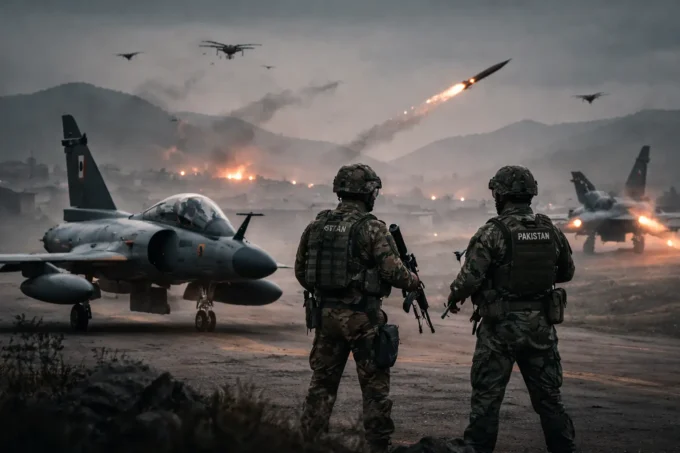
It is evident that the nuclearization of India and Pakistan has not made conventional warfare obsolete because both countries have experienced a significant war and military crisis since the 1998 nuclear tests, both with nuclear threats. The development of the institutions, doctrines, and delivery mechanisms required for the deployment of their nuclear arsenals has been achieved by both states. The militant attack on the Indian Parliament in December 2001 set off a significant crisis that ended short of war, including a tense standoff involving more than half a million troops that lasted for several months. In the end, all of the numerous conflict management discussions, agreements, and negotiations between Pakistan and India have proven to be pointless.
“the risk of an accident leading to nuclear war would be particularly great in South Asia where there would be almost no time to distinguish between a deliberate launch, an accident, or a false alarm”
Pakistan and India have engaged themselves in numbers of conflict management talks, negotiations and agreements but all of them proved to be futile in the end. The agreements like Tashkent Agreement in 1965, Shimla Accord in 1972, Lahore Declaration in 1998 and Agra Summit in 2004 proved to be major steps initially but in the end, they were violated. Nuclear weapons specifically India and Pakistan’s decisions to test in 1998 changed the nature of crises in South Asia. They created space for low-intensity covert (para)military adventurism (e.g., the Kargil incursion and surgical strikes). The international community, particularly the United States as a seasoned third-party crisis manager, should continue to increase its understanding of the underlying grievances behind crises in South Asia and encouraging methods to facilitate long-term resolution. Nuclear weapons continue to strengthen strategic stability in South Asia by ensuring deterrence from large-scale attacks and that the international community will intervene when a crisis appears on the verge of severe escalation.
Conflict management is moving at a snail pace in South Asia. Inter-state conflicts in South Asia has their own dynamism. Suspicion and hatred built over decades will not evaporate overnight. Not only this, there is continuing hostility and mistrust between India and Pakistan. This is replicated, although, to a lesser extent in relations between India and its other neighbors. The process of „conflict management and resolution has witnessed various problems. However, these problems are more visible and sterner between India and Pakistan. Pakistan and India have never enjoyed friendly relationship for loner time rather both sides have remained hostile for most of the time in their mutual history. The Wars, border clashes and non-state militant attacks have increased the relational gap between them. Over the course of time the policies of both sides have hindered and failed the conflict management efforts.
The conflict resolution and management steps like diplomacy, negotiations and mediations have mostly ended in failure and efforts ended in futile. Both sides need to increase the communication through different channels like social, economic, diplomatic, and unofficial diplomatic windows. The conflict resolution of different issues between these states is not only necessary for them but also for the whole South Asian Region. Disturbed by issues of “poverty, joblessness, ignorance and over-population, the two nations are inadequate of assets critically required for mitigation of sufferings of people. According to the UN Human Development Index, India and Pakistan positioned at 130 and 147 individually among 188 nations in 2015. But, they are contributing gigantic assets on military capacities and atomic weapons to the detriment of human security needs.
The lessons of Cold War arms control suggest that with numerous complex issues as those of India and Pakistan and to avert a nuclear holocaust in South Asia, the prior resolution of conflicts should not be made a prerequisite for initiation of dialogue on arms control. In view of the seriousness of the situation, a beginning needs to be made without awaiting the resolution of those conflicts. Of the five members of the UN Security Council, two i.e. United States and China stand disqualified for their role in conflict generation in South Asia. They are unacceptable to Indians for their partisan role.
The third, Britain, has vested interests right from the inception of the partition plan. The other two i.e. Russia and France, do not carry much strategic weight today. The absence of “honest brokers” for negotiating an end to South Asia’s Indo-Pak conflict seriously impedes any conflict resolution process. As India and Pakistan have number of confrontations with each other the only solution for this issue is to bring consistency in dialogue and international community must help them to find a solution. Pakistan and India need to establish constant communication channels which can even work during the hostile times. The trust building measures must be taken by both governments through cross border interactions of different social groups like students, businessmen, diplomats and academics.