









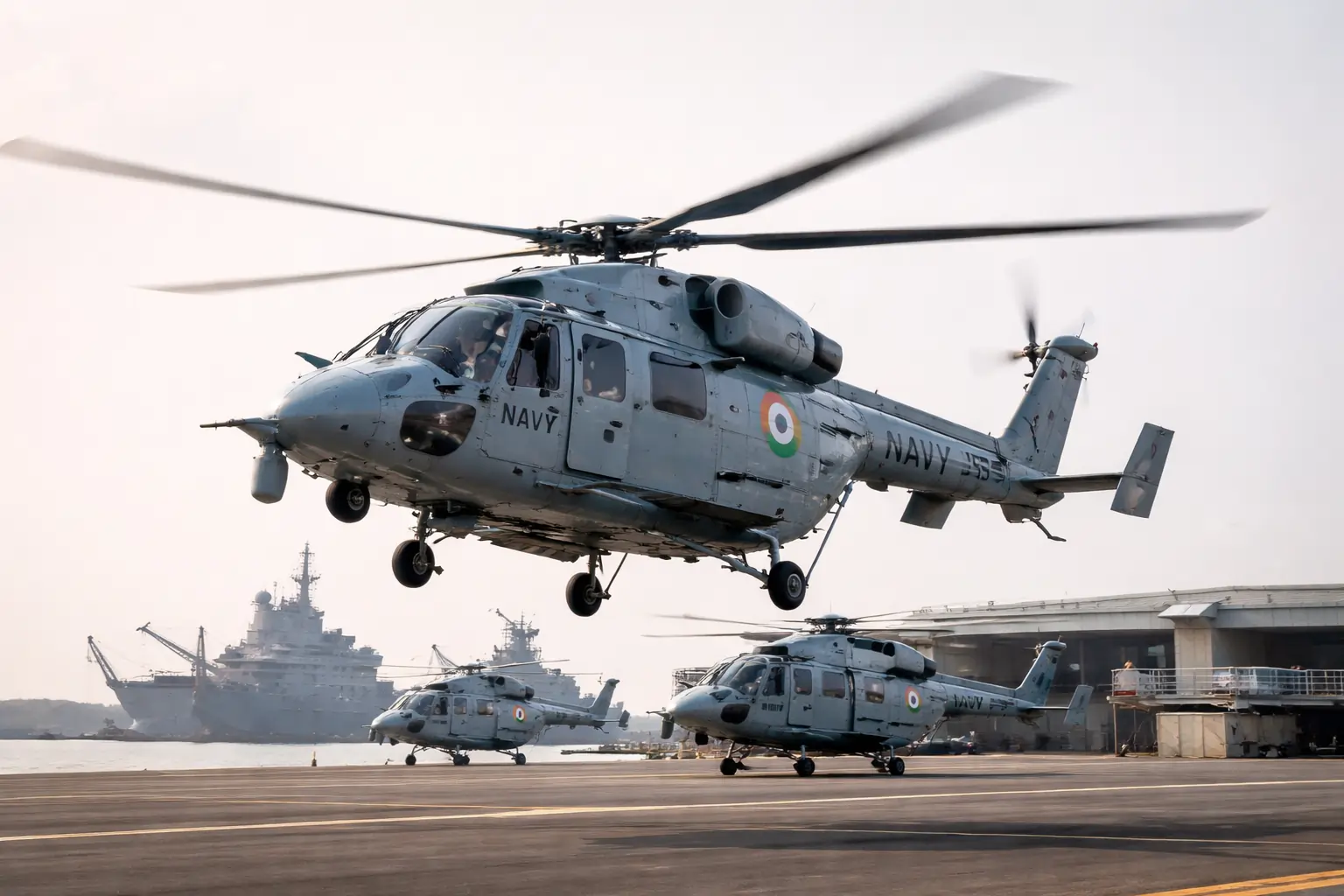
After one of the longest groundings in Indian Navy history, the Advanced Light Helicopter (ALH) fleet is set to slowly return to the skies, but with strict limits and a phased restart.
The helicopters were grounded after a tragic crash in January last year, when an ALH of the Indian Coast Guard lost control in Porbandar, killing two pilots and a crewman. Early analysis showed the helicopter stopped responding to pilot controls just seconds before impact, forcing the manufacturer Hindustan Aeronautics Limited (HAL) to ground the entire fleet.
Later Investigations found the cause to be a catastrophic failure of a key part called the non-rotating swash plate (NRSP). This component plays a crucial role in passing pilot control inputs to the main rotor. Once it failed, the helicopter lost cyclic control, leaving no chance of recovery.
During the year-long grounding, HAL inspected the entire ALH fleet. Multiple cases of NRSP fatigue failure were found, mainly in the wheeled ALH Mk3 Maritime Role helicopters used by the Navy and Coast Guard.Interestingly, similar issues were not seen in the skid-based versions flown by the Army and Air Force, which were cleared to resume operations earlier.
The faulty batch of NRSPs has now been removed and is being replaced with new components. Flying will now resume gradually, using new NRSPs with reduced service life, while HAL is working on long-term fixes such as redesign, better materials, and improved manufacturing methods.














Leave a comment